Practice point

Evidence-informed diagnosis of cerebral palsy in community settings

Posted: Sep 23, 2026
Principal author(s)
Ram Mishaal MD, Mor Cohen-Eilig MD, Vivian Wong MSc, Scott McLeod MD; Canadian Paediatric Society, Mental Health and Developmental Disabilities Committee, Developmental Paediatrics Section
Abstract
Paediatricians in community practice may encounter an infant or toddler who “just isn’t moving quite right” but who has no apparent perinatal risk factors for cerebral palsy (CP) and otherwise seems to be thriving. CP is the most common physical disability in childhood, occurring in approximately 1 in 400 children in Canada, yet diagnosis is often delayed even in cases where evidence of risk for CP in infancy is strong. The average age for a CP diagnosis in Canada is 19 months but it can take much longer in some regions, which in turn delays initiation of evidence-based interventions such as constraint-induced movement therapy and other goal-directed, child-led therapies. This practice point provides guidance for paediatricians and other primary care providers on the subtler signs of CP in young children born term or near-term, for whom delays in diagnosis happen more often than for those born prematurely, and on first steps toward ensuring these children and their families receive the timely supports they need.
Keywords: Cerebral palsy; Diagnostic techniques; Early diagnosis
Cerebral palsy (CP) is an early-onset, lifelong neurodevelopmental condition characterized by limitations of movement and posture which can manifest as spasticity, dystonia, choreoathetosis, ataxia, or some combination of these impairments. Heterogeneity of presentation in CP can present challenges to early diagnosis for community health care providers (HCPs) who may feel unsure when faced with an infant or toddler who “just isn’t moving quite right”. This infant might be sitting late, or seem stiff or floppy or to favour one side. Perhaps a parent is worried about a strange crawling pattern or persistent head lag. There may be no immediately apparent perinatal risk factors in the history, and the infant or child may be thriving otherwise. Is this clinical picture something to watch or something to act on?
This practice point provides guidance for HCPs working in community practice on the signs of CP in young children born term or near-term, for whom delays in diagnosis happen more often than for those born prematurely, and on first steps to take to ensure these children and their families receive the timely supports they need.
Why early recognition matters
CP is the most common physical disability in childhood, occurring in approximately 1 in 400 children in Canada. Despite its prevalence, diagnosis often happens late, even when evidence for the diagnosis presents in infancy. CP is a clinical diagnosis that can typically be made before a child is 18 months of age. In Canada, the average age of diagnosis is 19 months, but the process can take much longer in some regions, which can delay evidence-based interventions such as constraint-induced movement therapy (CIMT) and other goal-directed, child-led therapies. Individual patient journeys often include visiting multiple therapists and physicians before a formal diagnosis of CP is made [1]. One study found that many parents of children with CP felt their child’s diagnosis was made too late [1]. Delays in diagnosis can result in missed windows for specific early interventions, lost opportunities for neuroplasticity-driven therapy [2]-[4], and parental confusion. Paediatric care providers have an essential role in recognizing signs of CP early and initiating referrals for diagnostic evaluation, especially in atypical or less clear-cut cases, and in initiating therapeutic interventions as required.
The timely diagnosis of CP can facilitate early, targeted interventions, improve anticipatory guidance and care, and decrease parental anxiety. Select resources to assist diagnosis, prompt early targeted interventions, and communicate effectively with families are offered following this practice point. The benefits of early diagnosis include:
- Timely access to evidence-based therapy (e.g., bimanual or CIMT for unilateral spastic CP) [5], equipment (e.g., positioning supports, orthoses), and care coordination
- Improved motor outcomes and participation [6]
- Reduced stress and uncertainty for caregivers [7][8]
- More informed anticipatory guidance from paediatric providers [9].
For children with unilateral spastic CP (hemiplegia), CIMT is an evidence-based treatment that facilitates movement in an affected hand and upper limb by restricting movements on the stronger or dominant side. Different protocols exist but often involve using a glove or mitt on the dominant limb to strengthen reliance on the affected side and encourage task-specific practice of activities relevant for the child (e.g., picking up items, buttoning clothing), and gradually shaping therapeutic activities to meet the child’s goals. CIMT prevents learned non-use of an affected limb in unilateral spastic CP. Paediatric care providers can make a significant difference through early detection and acting on early signs.
When to suspect CP
Parents are often the first to detect early warning signs for CP, and their concerns must be taken seriously. CP should be considered when a child shows delayed or asymmetric motor milestones, even in the absence of known risk factors (Table 1). Research shows that one-half of children with CP have had a relatively healthy perinatal course [1].
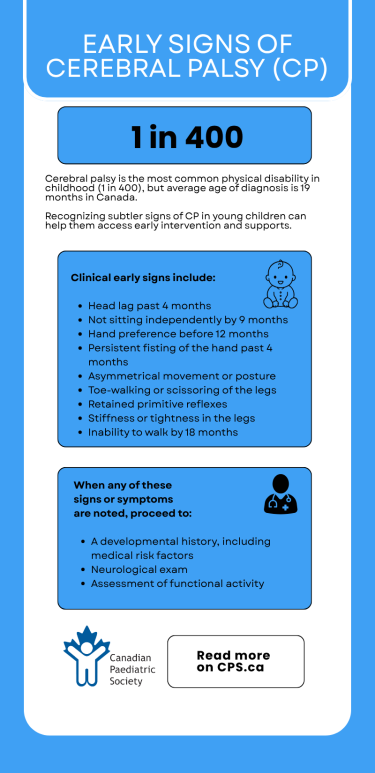
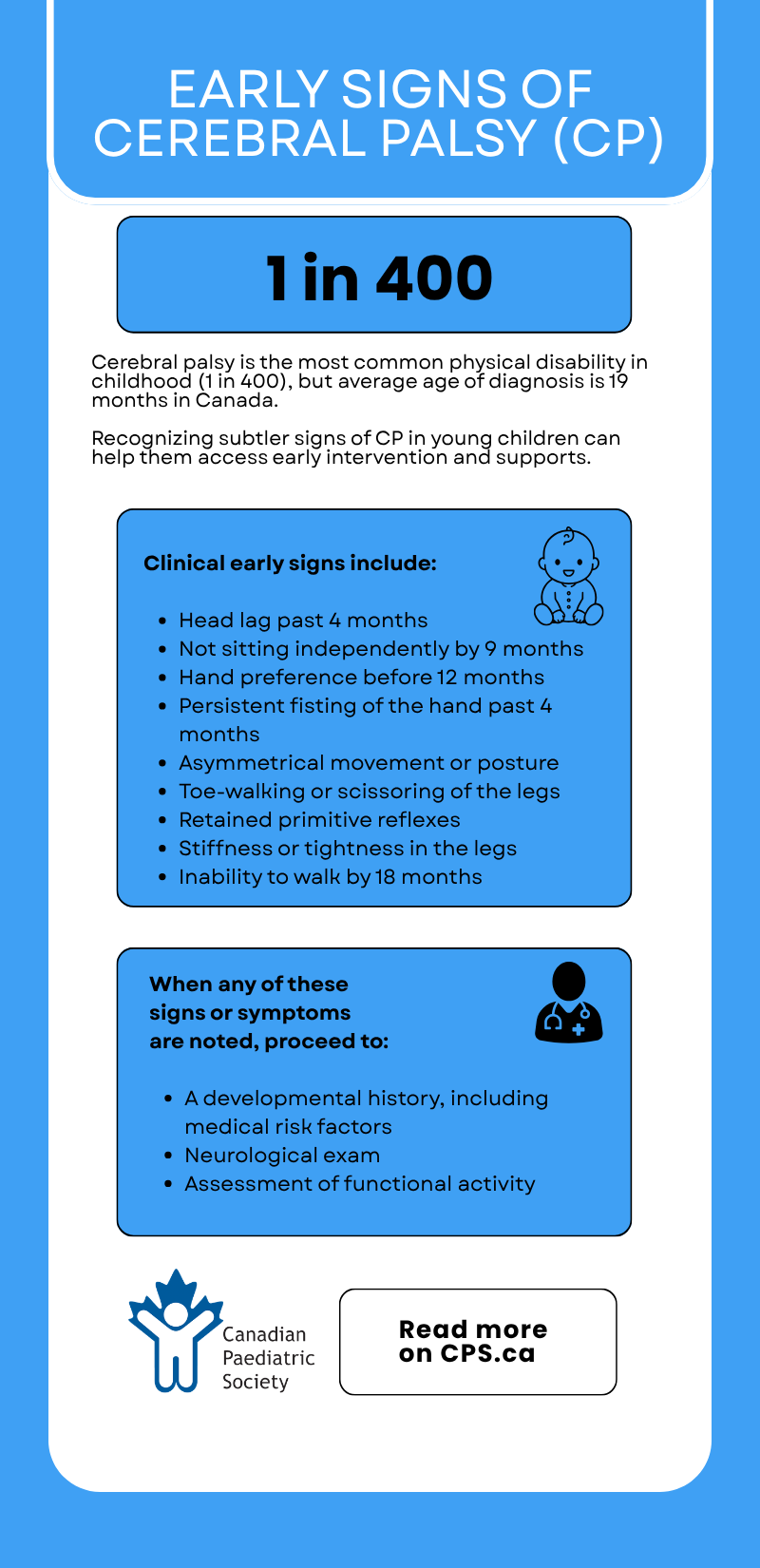
Clinical early signs [10] include:
- Not sitting independently by 9 months
- Hand preference before 12 months
- Persistent fisting of the hand past 4 months
- Asymmetrical movement or posture
- Toe-walking or scissoring of the legs
- Retained primitive reflexes
- Stiffness or tightness in the legs
- Inability to walk by 18 months [11][12]
- Head lag past 4 months
For a visual resource of these signs, visit Early Detection of CP, at the Child Disability Link website [13].
If any of these signs or symptoms are noted, a careful developmental history and neurological examination should follow. The presence on history of known medical risk factors for CP (Table 1) should similarly lead to a detailed history and examination.
Table 1. Medical risk factors for cerebral palsy (CP) (Odds ratio >10) |
|
Information drawn from reference 12
CNS Central nervous system, HIE Hypoxic-ischemic encephalopathy
How is CP diagnosed?
CP is a clinical diagnosis. The following three elements must be present:
- Evidence of a non-progressive brain disturbance occurring in early development supported by either:
- Medical factors associated with CP (Table 1) OR
- Delayed acquisition of motor milestones
- Motor dysfunction on neurological examination (one of the below is required):
- Presence of spasticity, dystonia, choreoathetosis, or ataxia OR
- Upper motor neuron features (brisk deep tendon reflexes, extensor plantar response, differences in motor control)
- Functional limitations in motor activities (observed, reported, or both)
Magnetic resonance imaging (MRI) is important for exploring etiology but is not mandatory for diagnosis. In children with hemiplegic CP, possible causes are a stroke or cerebral malformation, and in spastic bilateral CP, which is common in children born preterm, periventricular white matter injury may be implicated. In either case, do not delay referral for targeted interventions while awaiting imaging. MRI can identify the etiology of CP in about 85% of all cases. Term and near-term born children have fewer white matter injuries, and may have a greater likelihood of genetic etiologies, particularly in the absence of risk factors, which slightly reduces the MRI yield in this population [14].
What to assess
1. History:
- Prenatal/perinatal history (e.g., prematurity, neonatal intensive care unit stay, encephalopathy)
- Early motor development (delays, asymmetry, unusual movement patterns)
- Family history of neurological or developmental conditions
- Ask about regression. If present, consider differential diagnoses like neurodegenerative or neuromuscular conditions.
2. Neurological exam:
- Tone: Spasticity (velocity-dependent), dystonia (fluctuating), or hypotonia
- Reflexes: Brisk, asymmetric, or persistent primitive reflexes
- Posture and movement: Abnormal patterns, fisting, asymmetry, or lack of variability
- Gait: Toe-walking, scissoring, asymmetry, or instability
Signs of generalized hypotonia or absent reflexes may point to neuromuscular disease and warrant further investigation.
3. Functional activity: Observe whether the child can complete age-appropriate gross motor tasks (e.g., sitting, crawling, walking). Are there delays or asymmetries? Use corrected age for preterm infants.
Screening tools to support assessment
The Hammersmith Infant Neurological Examination (HINE) [15] is a validated tool for assessing infants 2 to 24 months of age. It is a standardized infant neurological examination reviewing cranial nerves, posture, movements, tone, reflexes, and developmental milestones [16][17]. The HINE screen takes about 10 to 15 minutes to complete and can:
- Help standardize documentation of neurological findings
- Identify abnormal signs and track changes over time.
Training materials on scoring and interpretation of the HINE results [18] and scoring sheets can be found at the Holland Bloorview Kids Rehabilitation Hospital website.
What to do in practice
Take a structured approach to clinical diagnosis of CP when signs are present and the child’s clinical picture includes criteria listed above.
- Use developmental history, a checklist of alerting signs, neurological examination, and HINE to support your findings.
- Refer children with concerns to targeted intervention programs (e.g., bimanual therapy, CIMT, physiotherapy to review equipment needs).
- For families who live in rural or remote settings, consider virtual consultation to support timely therapy referrals.
Communicating a CP diagnosis can be daunting for both clinicians and parents. Help prepare for this conversation by using tools such as the SPIKES protocol [19] to convey compassion and hope along with a diagnosis of disability. The SPIKES framework and checklist emphasize delivering the diagnosis in an appropriate setting, understanding family perceptions, seeking permission to share medical information, delivering information clearly, showing empathy, and summarizing [16][19]. Addressing stigma and cultural perceptions is also important because anticipatory counselling on stressors initiates earlier family connection with culturally and linguistically appropriate supports [20]. Parents value hopefulness, clarity about diagnostic tools used, and discussions of prognosis in early consultations [20][21]. Despite there always being some uncertainty in prognostication, using family-friendly tools such as the Gross Motor Functional Classification System (GMFCS) [22], highlighting strengths alongside challenges, and incorporating the F-Words [23]—Function, Family, Fitness, Fun, Friends, Future— can help frame the diagnosis in a hopeful and evidence-based manner [24].
When to pursue further investigations
While CP is typically diagnosed clinically, additional investigations (including neuroimaging, genetic investigations, or referral to specialists) should be strongly considered in the following situations:
- The history does not match clinical findings (e.g., an infant with an unremarkable birth history with progressive dystonia).
- The presentation suggests atypical CP, which may include neurological findings such as generalized hypotonia, ataxia, or fluctuating symptoms.
- There is evidence or parental report of developmental regression, which may point to a progressive or neurodegenerative condition.
MRI is strongly recommended in these cases to help clarify etiology, support care planning, and help rule out other diagnoses. In parallel, genetic testing, commencing with a chromosomal microarray (CMA) followed by referral to a medical genetics specialist, should also be considered. Genomic testing in these children is similar in approach to that used for children with GDD or IDD [25]. Identifying a unifying genomic condition may also provide supportive information for families.
When hypotonia and weakness are present, strongly consider prompt investigations for treatable neuromuscular conditions such as spinal muscular atrophy and Duchenne’s muscular dystrophy.
Best practice points
- CP is a heterogeneous entity that can be challenging to diagnose for community providers, but early recognition and response provides optimal opportunities for treatment and outcomes.
- CP is a clinical diagnosis that can often be made before 18 months of age.
- Paediatric care providers play a critical role in recognizing early, subtle signs of CP and initiating referrals for therapeutic intervention, and for diagnostic evaluation in atypical or less clear-cut cases.
- Timely action leads to specific, targeted interventions for CP and to anticipatory guidance and care that is CP- and child/family-specific and can decrease parental anxiety.
Recommended resources
- HINE training materials at the Holland Bloorview Rehabilitation Hospital website.
- B.C. Cerebral Palsy Community Diagnostic Care Pathway
- University of British Columbia Continuing Professional Development, BC Children’s Hospital. Cerebral Palsy Diagnosis: Toolkit for Community Health-care Providers. Updated December 2024.
Acknowledgements
This practice point was reviewed by the Community Paediatrics Committee of the Canadian Paediatric Society.
CANADIAN PAEDIATRIC SOCIETY MENTAL HEALTH AND DEVELOPMENTAL DISABILITIES COMMITTEE (2025-2026)
Members: Scott McLeod MD (Chair), Amy Ornstein MD (Board Representative), Megan Thomas MBCHB, Ripudaman Minhas MD, Lester Liao MD, Ghita Wiebe MD, Man Ying Bernice Ho BSC (Resident Member)
Liaisons: Olivia MacLeod MD (Canadian Academy of Child and Adolescent Psychiatry), Angela Orsino MD (CPS Developmental Paediatrics Section), Leigh Wincott MD (CPS Mental Health Section)
CANADIAN PAEDIATRIC SOCIETY DEVELOPMENTAL PAEDIATRICS SECTION (2025-2026)
Members: Iskra Peltekova MD (President), Angie Ip MD ( Vice President), Gurpreet (Preety) Salh MD (Past President), Jessica Lynch MD (Secretary-Treasurer), Elizabeth Young MD (Member at Large), Susan Bobbitt MD (Member at Large), Selamenesh Tsige Legas MD (Member at Large)
Liaisons: Alanna Jane BHSC (Resident), Asha Nair MD (Conference planning), Angela Orsino MD (Liaison to the CPS Mental Health and Developmental Disabilities Committee)
Principal authors: Ram Mishaal MD, Mor Cohen-Eilig MD, Vivian Wong MSc, Scott McLeod MD
Funding
There is no funding to declare.
Potential Conflict of Interest
Dr. Scott McLeod reported receiving compensation for serving on the advisory board of Ipsen Biopharmaceuticals. No other disclosures were reported.
References
- McIntyre S, Morgan C, Walker K, Novak I. Cerebral palsy—Don’t delay. Dev Disabil Res Rev 2011;17(2):114–29. doi: 10.1002/ddrr.1106
- Eyre J. Corticospinal tract development and activity-dependent plasticity. In: Shepherd RB, ed. Cerebral Palsy in Infancy: Targeted Activity to Optimize Early Growth and Development. London, U.K.: Elsevier; 2014.
- Martin JH, Chakrabarty S, Friel KM. Harnessing activity‐dependent plasticity to repair the damaged corticospinal tract in an animal model of cerebral palsy. Dev Med Child Neurol 2011;53(Suppl 4):9–13. doi: 10.1111/j.1469-8749.2011.04055.x
- te Velde A, Morgan C, Novak I, Tantsis E, Badawi N. Early diagnosis and classification of cerebral palsy: An historical perspective and barriers to an early diagnosis. J Clin Med 2019;8(10):1599. doi: 10.3390/jcm8101599
- Eliasson AC, Holmefur M. The influence of early modified constraint-induced movement therapy training on the longitudinal development of hand function in children with unilateral cerebral palsy. Dev Med Child Neurol 2015;57(1):89–94. doi: 10.1111/dmcn.12589
- Morgan C, Novak I, Dale RC, Guzzetta A, Badawi N. Single blind randomised controlled trial of GAME (Goals - Activity - Motor Enrichment) in infants at high risk of cerebral palsy. Res Dev Disabil 2016;55:256–67. doi: 10.1016/j.ridd.2016.04.005
- Williams SA, Alzaher W, Mackey A, et al. “It should have been given sooner, and we should not have to fight for it”: A mixed-methods study of the experience of diagnosis and early management of cerebral palsy. J Clin Med 2021;10(7):1398. doi: 10.3390/jcm10071398
- Avieli H, Band-Winterstein T. “What didn’t I do for this child?”: Parents’ retrospective construction of their child’s CP diagnostic process. J Dev Phys Disabil 2017;29(3):385–405. doi: 10.1007/s10882-016-9531-z
- Karamura A, Makino A, McLeod S; Canadian Paediatric Society, Developmental Paediatrics Section. Comprehensive care of the ambulatory child with cerebral palsy (GMFCS I and II): A Canadian perspective. Paediatr Child Health 2020;25(6):397.
- Boychuck Z, Andersen J, Bussières A, et al. International expert recommendations of clinical features to prompt referral for diagnostic assessment of cerebral palsy. Dev Med Child Neurol 2020;62(1):89–96. doi: 10.1111/dmcn.14252
- Shaunak M, Kelly VB. Cerebral palsy in under 25 s: Assessment and management (NICE Guideline NG62). Arch Dis Child Educ Pract Ed 2018;103(4):189–93. doi: 10.1136/archdischild-2017-312970
- B.C. Cerebral Palsy Advisory Committee. Evidence Informed Care for Children with Cerebral Palsy in British Columbia 2017-2021: Executive Summary and Final Report. Vancouver, B.C.: Sunny Hill Health Centre, BC Children’s Hospital; 2021. (Internal report, Provincial Health Services Authority, British Columbia Children’s Hospital.)
- Montreal Children’s Hospital, McGill University Health Centre. Childhood Disability Link. Early Detection of CP (Accessed May 25, 2026).
- Horridge KA, Johnston J, Phatak V, Guadagno A. Magnetic resonance imaging of the brain in children and young people with cerebral palsy: Who reports matters? Dev Med Child Neurol 2011;53(4):375–7. doi: 10.1111/j.1469-8749.2010.03880.x
- Romeo DM, Ricci D, Brogna C, Mercuri E. Use of the Hammersmith Infant Neurological Examination in infants with cerebral palsy: A critical review of the literature. Dev Med Child Neurol 2016;58(3):240–5. doi: 10.1111/dmcn.12876
- Dubowitz L, Mercuri E, Dubowitz V. An optimality score for the neurologic examination of the term newborn. J Pediatr 1998;133(3):406–16. doi: 10.1016/s0022-3476(98)70279-3
- Hay K, Nelin MA, Carey H, et al. Hammersmith Infant Neurological Examination asymmetry score distinguishes hemiplegic cerebral palsy from typical development. Pediatr Neurol 2018;87:70–4. doi: 10.1016/j.pediatrneurol.2018.07.002
- Fehlings D, Makino A, Church P, et al. The Hammersmith Infant Neurological Exam Scoring Aid supports early detection for infants with high probability of cerebral palsy. Dev Med Child Neurol 2024;66(9):1255–7. doi: 10.1111/dmcn.15977
- Novak I, Morgan C, McNamara L, te Velde A. Best practice guidelines for communicating to parents the diagnosis of disability. Early Hum Dev 2019;139:104841. doi: 10.1016/j.earlhumdev.2019.104841
- Church PT, Banihani R, Thomas K, et al. Early identification and communication in cerebral palsy: Navigating a collaborative approach for neonatal follow‐up programmes. Acta Paediatr 2025;114(2):292–8. doi: 10.1111/apa.17458
- Byrne R, Duncan A, Pickar T, et al. Comparing parent and provider priorities in discussions of early detection and intervention for infants with and at risk of cerebral palsy. Child Care Health Dev 2019;45(6):799–807. doi: 10.1111/cch.12707
- CanChild/McMaster University. GMFCS – E&R (The Gross Motor Function Measure – Expanded and Revised) (Accessed May 26, 2026).
- CanChild/McMaster University. F-words for Child Development (Accessed May 26, 2026).
- Rosenbaum P, Gorter JW. The ‘F‐words’ in childhood disability: I swear this is how we should think! Child Care Health Dev 2012;38(4):457–63. doi: 10.1111/j.1365-2214.2011.01338.x
- McLeod S, Kawamura A, Orsino A; Canadian Paediatric Society, Mental Health and Developmental Disabilities Committee. Assessing children and youth with global developmental delay and intellectual developmental disorder. March 27, 2026.
Disclaimer: The recommendations in this position statement do not indicate an exclusive course of treatment or procedure to be followed. Variations, taking into account individual circumstances, may be appropriate. Internet addresses are current at time of publication.