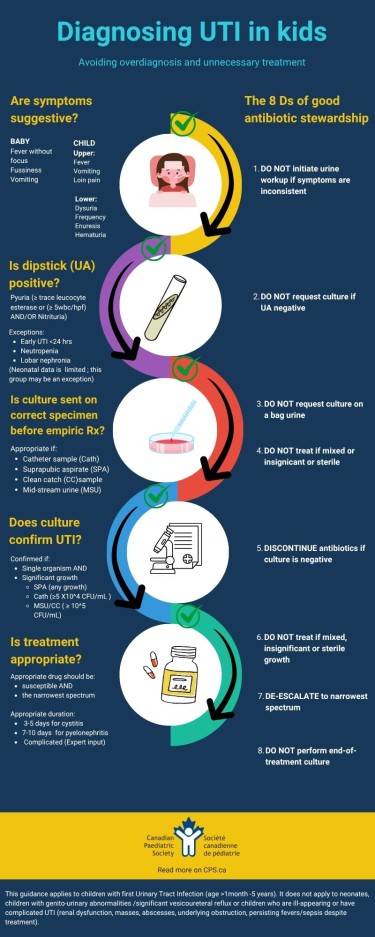
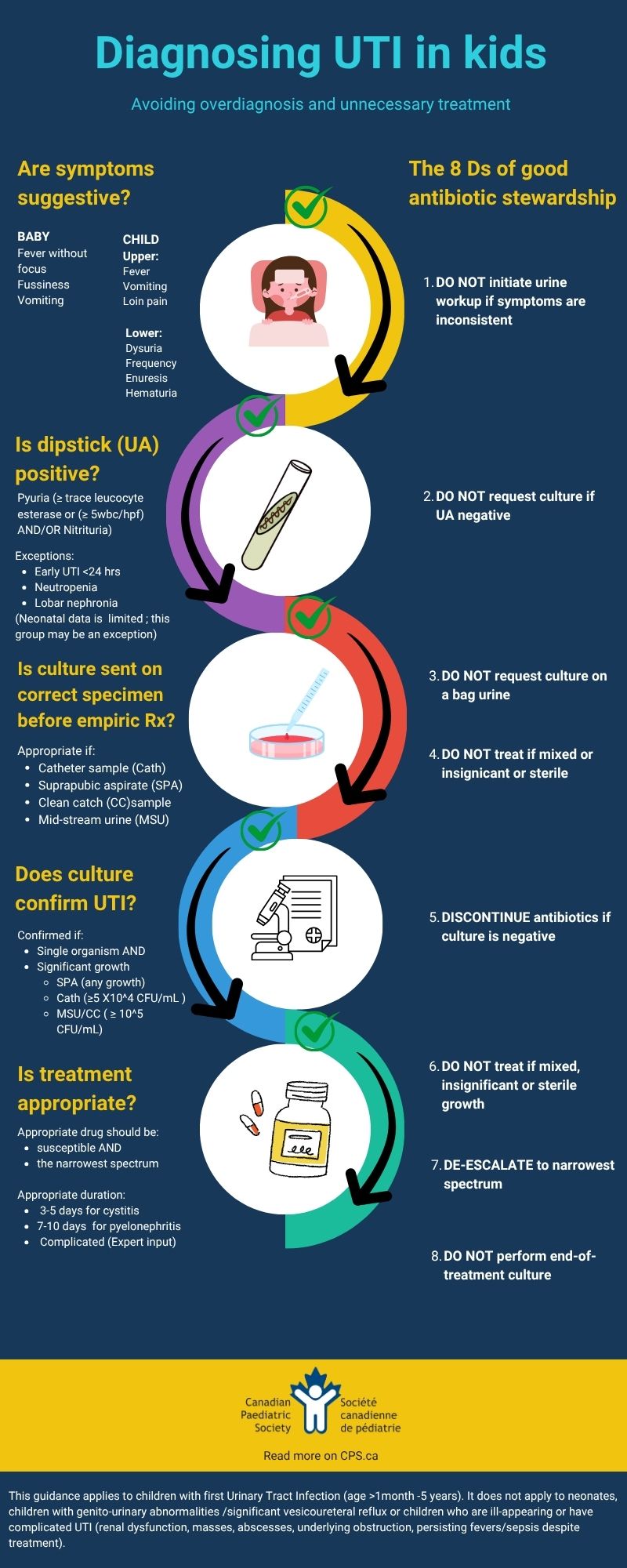
Position statement

Optimizing management of urinary tract infections in children: A need for improved stewardship

Posted: Aug 25, 2026
Principal author(s)
Michelle Barton MD, Isabelle Viel-Thériault MD, Rupeena Purewal MD; Canadian Paediatric Society, Infectious Diseases and Immunization Committee
Abstract
Urinary tract Infections (UTIs) are one of the most common childhood infections. Challenges around urine testing contribute to overdiagnosis and unnecessary antibiotic use. This statement updates a previous Canadian Paediatric Society document while focusing on the diagnosis and management of first UTIs in children 1 month to 5 years old and integrating essential principles of antimicrobial stewardship. UTIs in children with genitourinary system abnormalities other than grade 1 to 3 vesico-ureteric reflux are not addressed. Symptomatic children with supportive urinalysis should have a urine culture performed on an appropriately collected sample. Based on culture results, empiric antimicrobials should be discontinued or de-escalated to narrowest spectrum therapy, with completion of at least 7 days for uncomplicated pyelonephritis and 3 to 5 days for cystitis. Infants <2 months old, who have a higher risk for invasive bacterial infection, and children with complicated UTI may require additional investigations and longer courses of parenteral therapy.
Keywords: Antibiotic stewardship; Bacteriuria; Cystitis; Pyelonephritis; Pyuria; Urinalysis; UTI
Epidemiology, incidence, and definitions
Urinary tract infections (UTIs) are the leading cause of bacterial infections in febrile children. A diagnosis of UTI is made in 10% to 17% of infants younger than 3 months of age evaluated for fever, with up to 5% to 10% of UTI episodes associated with bacteremia[1]-[3]. In children younger than 2 years of age who have fever without a focus[4][5], the overall prevalence of UTIs is around 7%, with a higher risk in infants younger than 6 months of age, girls, and uncircumcised boys[6].
UTI definitions are provided in Box 1.
Box 1. Definitions of UTI-related terms
Urinary tract infection (UTI): Pyuria or nitrituria AND significant growth of a single uropathogen in a child with compatible symptoms. Febrile UTI (F-UTI) or presumed pyelonephritis: UTI with fever and/or other systemic features including kidney-related symptoms (in verbal children). Elevated inflammatory markers (IMs) may be present. Afebrile UTI (aF-UTI) or presumed cystitis: UTI with bladder-specific symptoms (BSS) but without fever, systemic symptoms, or elevated IMs. aF-UTI usually presents in a continent child. Complicated UTI (c-UTI): Any UTI with concerns for renal dysfunction (e.g., poor flow, increased creatinine), abdomino-pelvic mass(es), abscess(es), or persistent fever despite 48 to 72 hours of antibiotic treatment. Asymptomatic bacteriuria (AB): Growth of >105 colony-forming units/mL of one or more bacteria in the absence of pyuria in an appropriately collected specimen from an asymptomatic child. Note: An aF-UTI does not necessarily indicate cystitis in infants <2 months old, who can have pyelonephritis without fever. |
Unnecessary antimicrobial use can cause adverse effects and contributes to the emergence of community-acquired, multidrug-resistant (MDR) UTIs, including those caused by extended-spectrum beta-lactamase-producing Enterobacterales (ESBL-E) and carbapenem-resistant Enterobacterales (CRE). ESBL-E and CRE are also frequently resistant to other classes of antibiotics, including quinolones and sulfonamides, limiting treatment options. The increasing prevalence of MDR UTIs is of significant concern due to implications for treatment (e.g., increasing need for parenteral therapy), health care costs, and patient outcomes. Strategies to improve diagnostic accuracy and integrate the best principles of antimicrobial stewardship into essential care are highlighted in this statement.
Improving diagnostic accuracy
Strategies to promote diagnostic accuracy include restricting urine culture requests to symptomatic children whose dipstick urinalysis (UA) supports a UTI, and ensuring cultures are performed using appropriately collected urine specimens. Accurate interpretation of culture results is also essential to prevent overdiagnosis and inappropriate antibiotic usage.
When should investigations for possible UTI be undertaken?
Investigation for UTI should only be initiated when clinical features are consistent with cystitis or pyelonephritis.
In verbal children, the presence of irritative bladder symptoms (i.e., dysuria, frequency, hematuria, suprapubic discomfort, or new-onset enuresis) suggests cystitis. Associated features of systemic illness (e.g., fever, nausea, vomiting) along with abdominal or loin pain or renal angle tenderness suggest pyelonephritis. Conditions such as balanitis, renal calculi, vulvovaginitis, and labial irritation (e.g., from bubble bath) can mimic UTI symptoms.
In nonverbal children, the features of UTI may be limited to pyrexia without a focus. Other non-specific features can include irritability, vomiting, or sepsis-like presentations. Changes in urine appearance and odour are generally unreliable indicators[7]. Online UTI calculators that incorporate risk factors can assist with clinical prediction of UTI in children 2 to 23 months old[8].
What are acceptable collection methods for urinalysis (UA) and urine culture?
Urine cultures should only be performed using clean catch urine (CCU), mid-stream urine (MSU), catheter urine (cath-U), or suprapubic aspirate (SPA) samples (Figure 1).
Dividing a collected sample in two allows a bedside UA to be performed as a first step. When pyuria is present, the remainder is sent for culture[9]. Bag-U samples are most useful in office settings when a UA is needed to evaluate an incontinent child with low pretest probability of UTI, or as a non-invasive way to confirm need for catheterization when parents are reluctant. Bag-U should be avoided in systemically ill children or those with high pretest probability of a UTI, because this method can delay initiation of antibiotic therapy due to the need for a second urine collection suitable for culture. In extremely ill infants, when treatment is initiated ahead of obtaining a sample, post-antibiotic sampling that confirms a positive UA may still support a presumptive diagnosis of UTI even when cultures are sterile.
The preferred specimen for urine culture in incontinent children is cath-U, based on low contamination rate. CCU is also feasible but is limited by long wait times for collection and high contamination rates (approaching 80%) in females and uncircumcised males. Pre-cleaning helps reduce risk of contamination[10]-[12].
Figure 1. Applying the eight D2 of antibiotic stewardship to UTI diagnosis and management
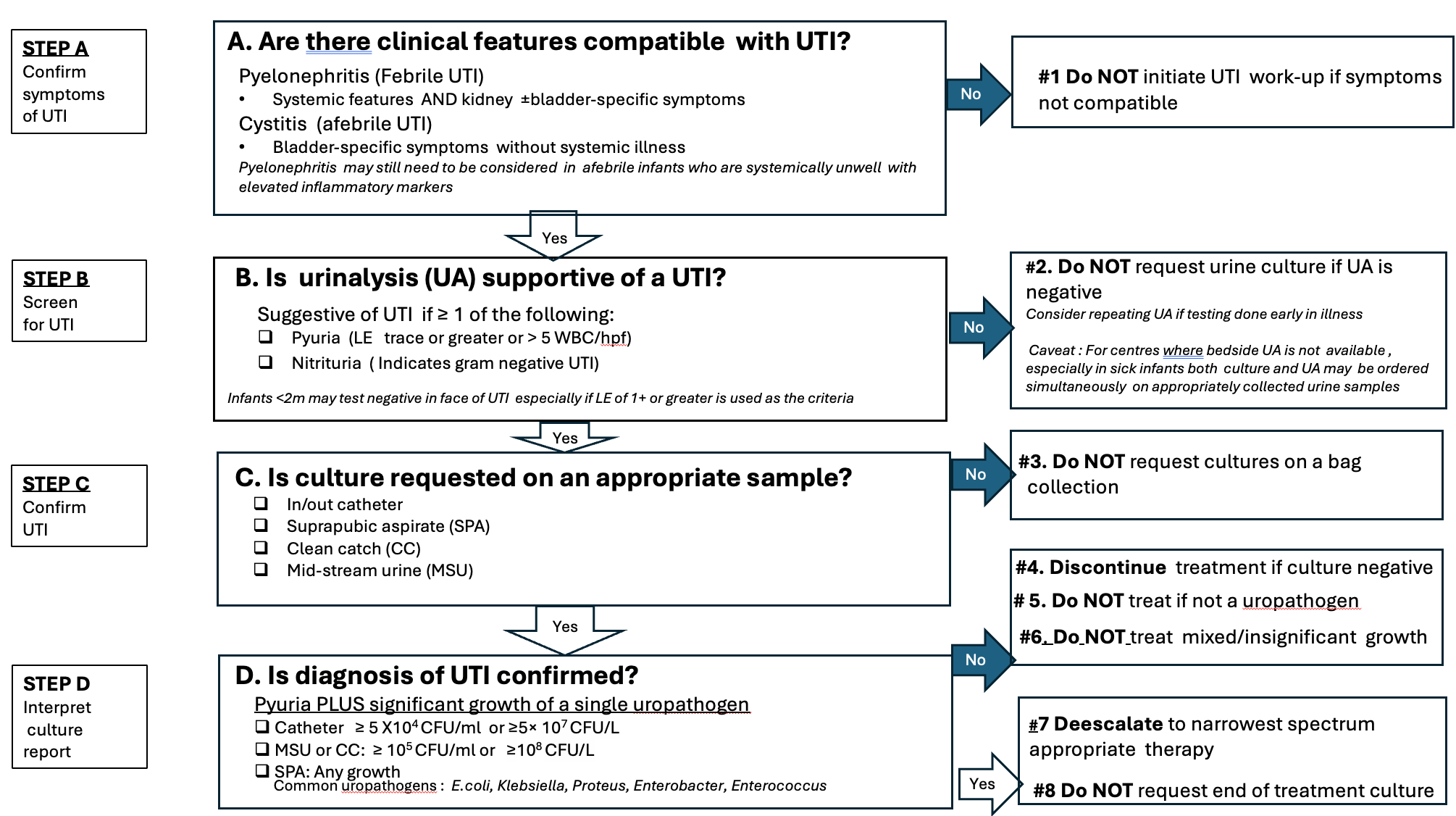
* If UA performed within 24 hours of illness onset, repeat UA if symptoms persist
UA urinalysis, CFU colony forming unit, LE leukocyte esterase, UTI urinary tract infection
Screening tests for UTIs: UA and microscopy
Children with clinical suspicion for UTI should have their urine screened for pyuria and nitrituria using a point-of-care dipstick UA before deciding on need for culture. Routine microscopy has limited utility, with data showing no significant added benefit from combining microscopy with dipstick UA over dipstick UA alone (sensitivity 94% versus 93%)[13]. While older studies[14] suggested low sensitivity of UA (48% versus 82%)[15] to detect UTI in infants <2 months old[16], a 2018 study of febrile infants <2 months old documented higher test performance for ≥trace leucocyte esterase (LE) or nitrituria (sensitivity 93%; specificity 95% for any F-UTI)[13]. A 2024 study[17] conducted in children <3 years of age showed that 20% of UTIs may be missed at LE cut-offs ≥1+. However, at LE cut-offs ≥trace, high sensitivity and specificity (91%; 92%) were found[17], as in the 2018 study[13][18]. Combining LE cut-offs ≥trace with nitrituria resulted in no more than 8% of UTI cases being missed. Pyuria at ≥trace LE, when combined with nitrituria, optimizes detection and minimizes false positivity from asymptomatic bacteriuria and contamination.
Pyuria (>5 WBC/hpf) can be detected biochemically by the presence of LE[13] and is an important diagnostic feature of UTI[9]. Non-infectious causes of pyuria include Kawasaki disease, hypercalciuria, and appendicitis[18]. UTI may occur without pyuria in these cases: partially treated or early (<24 hours) UTI, patients with significant neutropenia[19], or lobar nephronia[20], or if the uropathogen is Enterococcus or Pseudomonas[21]. The latter tends to occur more frequently in children with genitourinary (GU) anomalies[22].
Nitrituria results from the conversion of dietary nitrates within the bladder by gram-negative bacteria (except Pseudomonas and most Acinetobacter species[23])[9]. UTIs caused by gram-positive organisms (e.g., Enterococcus species, S. saprophyticus) do not produce nitrites[24]. Although nitrituria exhibits poor sensitivity in children <2 months old (24% to 38%)[13], its presence is considered highly indicative of a UTI (specificity 99%) at any age. A recent opinion piece challenges this, suggesting that isolated nitrituria may suggest AB or bacterial contamination[25].
As the negative predictive value of urinalysis exceeds 95%, the absence of pyuria (≥trace LE) or nitrituria, with a few exceptions, supports not proceeding to culture[26]. For persistently symptomatic children with initially negative UAs, a repeat UA within 24 to 48 hours may reduce the chances of missing an early UTI. In scenarios with negative repeat UA testing where the pretest probability is high, or when clinical concerns persist in absence of another diagnosis, it is reasonable to proceed to a urine culture.
Confirming UTIs: Interpretating the urine culture
Culture confirmation is essential for diagnosis and antibiotic management of UTIs. Urine should be collected before initiating antibiotics because a single dose of antibiotic can render urine culture negative. To avoid bacterial overgrowth, urine samples should be processed within 2 hours or within 24 hours if promptly refrigerated. Significant growth of a single recognized uropathogen, along with a positive UA in a symptomatic child, confirms the UTI diagnosis. Colony-forming unit (CFU) counts of any amount for SPA, ≥5 x 10⁷CFU/L for a catheter specimen and ≥108CFU/L for CCU or MSU, are considered significant[27] (Figure 1). Low colony counts rarely occur with a true UTI because frequent micturition limits bacterial concentration.
A low colony count most often reflects contamination or prior receipt of antibiotics. Growth of non-uropathogens (e.g., Lactobacillus, Corynebacterium, viridans streptococci, or Staphylococcus epidermidis) or polymicrobial growth, even when uropathogenic, usually reflects contamination.
First UTIs in healthy children are usually caused by Escherichia coli or Klebsiella species but may occasionally be caused by other Enterobacteriaceae (e.g., Enterobacter species) or by Enterococcus species. Other causes include Group B Streptococcus (infants <3 months) and Staphylococcus saprophyticus[28] (in adolescent females). The growth of MDR Enterobacterales, Pseudomonas species, or Enterococcus species is more common in recurrent or catheter-related UTIs, and may increase suspicion for GU anomalies[22][29].
End-of-treatment cultures should be avoided because positive growth resulting from AB can be misinterpreted as persisting UTI.
Other tests
Blood cultures are indicated at any age when ill-appearance or clinical features of sepsis are present, with a lower threshold for testing febrile infants <2 to 3 months old. Elevated inflammatory markers (IMs) such as C-reactive protein (CRP) and procalcitonin, especially in young infants, may support the diagnosis of pyelonephritis or invasive bacterial infection (IBI). Documentation of baseline renal function in children with pyelonephritis is important, and continued monitoring is recommended when aminoglycoside therapy is continued beyond 48 hours[30].
Management
Hospitalization
Most children with uncomplicated UTI can be treated as outpatients. Hospitalization is appropriate for children with F-UTI who are systemically unwell, have features suggestive of urosepsis or meningitis, or have complicated UTI (c-UTI). Children with c-UTI require urgent imaging to exclude conditions such as abscess, acute lobar nephronia, pyonephrosis, or obstruction, and require longer duration of parenteral therapy[31][32]. Subspecialty (nephrology, urology, or infectious diseases) involvement is usually required.
Hospitalization may also be necessary for parenteral therapy of MDR F-UTI when there is no appropriate oral treatment option and outpatient parenteral therapy is not available. Febrile infants <2 months old, who are at higher risk for IBI, require careful evaluation and admission while awaiting defervescence and pending cultures, especially if clinical or laboratory concerns for sepsis are present[2]. Outpatient parenteral antimicrobial therapy pending culture results may be an option for infants without central nervous system (CNS) concerns (i.e., otherwise well-appearing without elevated IMs) provided close follow-up is assured[2].
Empiric antibiotic therapy (Table 1)
Decision-making around empiric antibiotic therapy should take the following factors into consideration: likely pathogens (based on past culture results), local antibiotic resistance rates, disease severity (upper versus lower tract, co-associated IBIs, and complications), and underlying host conditions (e.g., allergies, organ dysfunction). Empiric oral options should prioritize the agents least likely to select for resistant organisms, such as cephalexin, provided local resistance is low. Alternatives include trimethoprim-sulfamethoxazole (TMP-SMX), amoxicillin-clavulanate, and cefixime. As cefixime is a strong driver of resistance, its preferred use would be for UTIs occurring in communities where resistance to first-line agents, like cephalexin and alternatives, is high. Parenteral options include aminoglycosides (preferably), or ceftriaxone. The latter, alone or combined with ampicillin, may be needed for ill-appearing young infants pending results of blood or cerebrospinal fluid cultures. If meningitis has been excluded and there are no contraindications, the use of aminoglycosides is less likely to select for drug resistance (compared with ceftriaxone). Aminoglycoside use has the advantage that coverage may extend to ESBL pathogens.
When MDR-UTI is suspected, empiric options should be guided by previous susceptibility results and local resistance rates, and should include nitrofurantoin (only for cystitis) or TMP-SMX, and parenteral agents like aminoglycosides (if there are no concerns for IBI). A carbapenem may be appropriate empiric therapy in some cases, depending on local epidemiology and the child’s clinical status at presentation.
Table 1. Antimicrobial agents used to treat urinary tract infections in children
Mode of administration | Drug | Dose | Comments |
Oral | Amoxicillin | 50 mg/kg/day | High resistance precludes empiric use. May be used as definitive therapy if isolate is susceptible |
Amoxicillin-clavulanate | (7:1 formulation) 40 mg/kg/day of amoxicillin component | An alternative when resistance to cephalexin is high | |
Cefixime | 8 mg/kg/day | Reserve for outpatient use when resistance to first-line agents is high | |
Cephalexin | Cystitis: 50 mg/kg/day | Preferred empiric therapy for non-MDR outpatient UTI, provided low resistance. Also used as definitive oral therapy if susceptible | |
Ciprofloxacin | 30 mg/kg/day | Reserve for MDR or pseudomonal UTI. ID involvement recommended | |
Nitrofurantoin | 5 to 7 mg/kg/day | Without kidney penetration, use is limited to cystitis | |
Trimethoprim-sulfamethoxazole | 8 mg/kg/day of trimethoprim component | May sometimes be an option in MDR UTI | |
Parenteral | Ampicillin | Non-CNS: 200 mg/kg/day IV | Definitive therapy (e.g., Enterococcus, and may be a part of sepsis regimens) |
Aminoglycosides: Gentamicin OR tobramycin | 5 to 7.5 mg/kg/day IV or IM | If no concerns for meningitis or sepsis, aminoglycosides are preferred as less likely to drive resistance. Therapeutic drug monitoring for use >48 hours. Request baseline renal function, then check every 48 to 72 hours If Pseudomonas is a concern, do not use gentamicin | |
Cefotaxime | Non-CNS: 200 mg/kg/day IV CNS: 300 mg/kg/day IV | Preferred therapy if CNS concerns exist | |
Ceftriaxone | Non-CNS: 50 to 75 mg/kg/day IV or IM CNS: 100 mg/kg/day IV | ||
Meropenem | Non-CNS: 60 mg/kg/day IV CNS: 120 mg/kg/day IV | Reserve for MDR-UTI (e.g., urosepsis). ID referral recommended |
Information drawn from references 1-8
Notes: The duration of therapy is as follows:
Cystitis: A 3-to-5-day course of oral antibiotics (nitrofurantoin requires a full 5-day course) OR, if parenteral therapy is indicated, a single dose of aminoglycoside or 1-3 days for other parenteral agents
Uncomplicated pyelonephritis: 7-10 days
Complicated UTIs require a longer treatment course, guided by ID
CNS Central nervous system
F-UTI febrile urinary tract infection, ID infectious diseases, IM intramuscular, IV intravenous, MDR multi-drug resistant, UTI urinary tract infection
Definitive therapy
De-escalation to the narrowest spectrum-appropriate agent is recommended as soon as susceptibility returns. Aminopenicillins and first-generation cephalosporins remain the preferred options for definitive therapy in drug-susceptible E. coli F-UTI and aF-UTI, with other oral options listed in Table 1. Paediatric data support single-dose aminoglycoside therapy as a safe, efficacious, and stewardly option for treating cystitis, particularly for MDR-cystitis without an oral option[33]. Once-daily dosing of an aminoglycoside for a minimum of 7 days allows outpatient therapy for aminoglycoside-susceptible MDR pyelonephritis. Other options for MDR-UTI, such as fosfomycin (not approved for children <12 years old), ciprofloxacin, and carbapenems, drive drug resistance and require ID guidance[34].
Parenteral-to-oral transition should be based on age, disease severity, and treatment response[3]. Based on a recent systematic review, transition at 3 days and 7 days was recommended for infants <3 months old with non-bacteremic and bacteremic UTIs, respectively[35]. In hospitalized infants ≥3 months old without concerns for sepsis, transition is encouraged at 24 to 48 hours following defervescence. Early transition does not apply for ill-appearing infants or any child with c-UTI who requires a longer parenteral therapy course. No trials published to date have addressed sole oral therapy or short course (<7 days) total therapy in infants <3months old[31]. Nonetheless, expert consensus supports sole oral therapy in well-appearing infants <2 months old when there are no clinical or laboratory concerns for IBI and providing close follow-up is assured[2].
Duration of therapy for confirmed UTI
Note that the duration recommendations provided here may not apply to c-UTI, where significant obstructive uropathy or focal collections can delay source control.
Afebrile UTI (aF-UTI): A Cochrane review found that in children with cystitis, a 1-day course of antibiotics was less effective, while a 2-to-4-day course did not differ significantly from a 7-to-14-day course[36]-[38]. Durations ranging from 1 day for fosfomycin[39][40], to 3 days for TMP-SMX[41] or fluroquinolones[42], to 5 days for nitrofurantoin[43] have been shown to be effective in adults. Based on these data, a 3-to-5-day course of oral antibiotic therapy for cystitis is recommended. In MDR cystitis, duration of therapy is 1 day for aminoglycosides or 3 days for other parenteral agents[33]. Some experts advocate treating an F-UTI in well-appearing older infants the same way. However, in younger infants <2 months old, the absence of fever cannot reassure against pyelonephritis, particularly when an infant is systemically unwell or has elevated IMs. For such cases treatment as per F-UTI is recommended.
Febrile urinary tract infection (F-UTI): The 2014 CPS statement[4] recommended 7 to 10 days of therapy for F-UTI[31], and a similar course was recently endorsed in UK[44] and Italian guidance[45]. For uncomplicated F-UTI, a minimum 7-day course is adequate, provided there is rapid improvement. No studies have assessed shorter course therapy in infants <3 months-old with F-UTI. With the exception of a randomized controlled trial (RCT) in children >3 months old by Montini et al[46], all other studies addressing treatment duration in children >3 months of age examined mixed populations of children with aF-UTI and F-UTIs[47][48], with F-UTI accounting for a minority of cases. A large SCOUT RCT (N=664) compared 5-day with 10-day oral therapy in children with non-bacteremic uncomplicated UTI[47] and found a significantly higher failure rate in the short-course arm. A recent meta-analysis (which included the SCOUT RCT[47] but not the Montini RCT[48]) also showed a higher failure rate in children receiving ≤5 days of therapy compared with ≥7 days of therapy (9.8% versus 5.4%)[48]. In contrast, the smaller RCT (N=142) from 2024 found that a 5-day course was non-inferior to a 10-day course of amoxicillin-clavulanate in children with uncomplicated F-UTI[46]. The authors did not specify whether bacteremic UTI was included.
In short, given the conflicting results between the two trials[46][47] and meta-analysis[48], there is insufficient evidence at present to routinely recommend antibiotic courses of less than 7 days for febrile UTIs. However, it may be reasonable to involve parents in shared decision-making for a 5-to-7-day course of antibiotics in children >3 months of age who have had rapid and complete clinical response, especially if the child is >2 years of age, to allow adequate assessment of symptom response. For this option, it is important to carefully weigh the potential benefits of limiting antibiotic exposure with the risk of treatment failure and make sure parents know when to return if they opt for a shorter course.
Renal and bladder ultrasound (RBUS)
RBUS aims is directed at detecting risk factors for UTI recurrence (e.g., anatomical GU abnormalities) and any complicated processes (e.g., perirenal abscess, pyonephrosis, or focal nephronia)[34]. UK guidelines[44] have recommended RBUS for infants <6 months of age, while North American guidelines[4][49] recommend RBUS for children <24 months at the time of their first UTI. The CPS supports the latter approach. Urgent RBUS is required for c-UTI but may also be scheduled within 6 weeks following treatment in uncomplicated UTI[50].
Voiding cystourethrogram (VCUG)
A VCUG is recommended[4][49] when features of high-grade vesico-ureteric refluxVUR, scarring, or hydronephrosis have been identified. VCUG may also be considered for children with recurrent F-UTIs[32] if they are younger than 6 months of age[32][44].
Recommendations
- Only request urine cultures in symptomatic children with pyuria or nitrituria.
A catheter sample is preferred for obtaining urine culture in incontinent children: Bag samples are inappropriate.
Most febrile urinary tract infection (UTI) cases can be treated with oral antibiotics on an outpatient basis. Exceptions include those with a complicated UTI or sepsis (more likely in infants younger than 2 months or when ill-appearance or elevated inflammatory markers are also present).
Empiric therapy should be guided by host factors and local resistance rates. First-line oral options include cephalexin, amoxicillin-clavulanate, and trimethoprim-sulfamethoxazole. Use of broad-spectrum agents like cefixime, which drive resistance, should be limited to scenarios where first-line agents are not options.
Ceftriaxone and aminoglycosides are common empiric parenteral options. Provided there are no concerns for meningitis, aminoglycosides are advantageous in that they are less likely to select for drug resistance than cephalosporins and thus may be an option in some multidrug-resistant UTIs.
Prompt follow-up of results from urine cultures is essential for transitioning to definitive therapy. When a culture excludes UTI, empiric antimicrobials should be discontinued.
Antibiotic therapy may be transitioned from the parenteral to oral route within 48 to 72 hours provided adequate response. Longer parenteral courses are required for ill-appearing children with concerns for sepsis or complicated UTI.
Recommended duration of therapy for uncomplicated UTI is 3 to 5 days for cystitis. In uncomplicated pyelonephritis, a 7-day course is usually adequate.
Acknowledgement
This position statement was reviewed by the Acute Care, Community Paediatrics, and Drug Therapy Committees of the Canadian Paediatric Society, and by representatives of the Association of Medical Microbiology and Infectious Disease Canada.
Canadian paediatric society infectious diseases and immunization committee (2024-2025)
Members: Michelle Barton MD (Chair), Laura Sauvé MD (Past Chair), Eugene Ng MD (Board Representative), Sean Bitnun MD, Sergio Fanella MD, Justin Penner MD, Jeannette Comeau MD MSc
Liaisons: Dorothy Moore MD (National Advisory Committee on Immunization), Sean Bitnun MD (Canadian Paediatric and Perinatal HIV/AIDS Research Group), Isabelle Viel-Thériault MD (Committee to Advise on Tropical Medicine and Travel), Marina Salvadori MD (Public Health Agency of Canada), Sean O’Leary MD (American Academy of Pediatrics, Committee on Infectious Diseases), Rupeena Purewal MD (Immunization Monitoring Program, ACTive), Cora Constantinescu MD (Association of Medical Microbiology and Infectious Disease Canada, Pediatric Committee)
Principal authors: Michelle Barton MD, Isabelle Viel-Thériault MD, Rupeena Purewal MD
Funding
There is no funding to declare.
Potential Conflict of Interest
Dr. R. Purewal reported receiving funding and an honorarium from Verity Pharmaceuticals for infectious diseases talk and ad board 2 years ago. She is currently a consultant for Verity Pharmaceuticals. No other disclosures were reported. All authors have submitted the ICMJE Form for Disclosure of Potential Conflicts of Interest.
References
Greenhow TL, Hung YY, Herz AM, Losada E, Pantell RH. The changing epidemiology of serious bacterial infections in young infants. Pediatr Inf Dis J 2014;33(6):595-9. doi: 10.1097/INF.0000000000000225
Pantell RH, Roberts KB, Adams WG, et al. Evaluation and management of well-appearing febrile infants 8 to 60 days old. Pediatrics 2021;148(2):e2021052228. doi:10.1542/peds.2021-052228
Aronson PL, Thurm C, Alpern ER, et al. Variation in care of the febrile young infant <90 days in US pediatric emergency departments. Pediatrics 2014;134(4):667-77. doi: 10.1542/peds.2014-1382
Robinson JL, Finlay JC, Lang ME, et al. Urinary tract infection in infants and children: Diagnosis and management. Paediatr Child Health 2014;19(6):315-9. doi: 10.1093/pch/19.6.315
Shaikh N, Morone NE, Bost JE, Farrell MH. Prevalence of urinary tract infection in childhood: A meta-analysis. Pediatr Infect Dis J 2008;27(4):302-8. doi: 10.1097/INF.0b013e31815e4122
Sorokan ST, Finlay JC, Jefferies AL; Canadian Paediatric Society, Fetus and Newborn Committee, Infectious Diseases and Immunization Committee. Newborn male circumcision. Paediatr Child Health 2015;20(6):311-20. doi: 10.1093/pch/20.6.311
Gauthier M, Gouin S, Phan V, Gravel J. Association of malodorous urine with urinary tract infection in children aged 1 to 36 months. Pediatrics 2012;129(5):885-90. doi: 10.1542/peds.2011-2856
Shaikh N, Hoberman A, Hum SW, et al. Development and validation of a calculator for estimating the probability of urinary tract infection in young febrile children. JAMA Pediatr 2018;172(6):550-6. doi: 10.1001/jamapediatrics.2018.0217
Diviney J, Jaswon MS. Urine collection methods and dipstick testing in non-toilet-trained children. Pediatr Nephrol 2021;36(7):1697-1708. doi: 10.1007/s00467-020-04742-w
Tosif S, Baker A, Oakley E, Donath S, Babl FE. Contamination rates of different urine collection methods for the diagnosis of urinary tract infections in young children: An observational cohort study. J Paediatr Child Health 2012;48(8):659-64. doi: 10.1111/j.1440-1754.2012.02449.x
Hoover AC, Segal RS, Zimmerman MB, et al. Urine trouble: Reducing midstream clean catch urine contamination among children 3–17 years old. Pediatrics 2021;148(2):e2020049787. doi: 10.1542/peds.2020-049787
Vaillancourt S, McGillivray D, Zhang X, Kramer MS. To clean or not to clean: Effect on contamination rates in midstream urine collections in toilet-trained children. Pediatrics 2007;119(6):e1288-93. doi: 10.1542/peds.2006-2392
Tzimenatos L, Mahajan P, Dayan PS, et al. Accuracy of the urinalysis for urinary tract infections in febrile infants 60 days and younger. Pediatrics 2018;141(2):e20173068. doi: 10.1542/peds.2017-3068
Bachur R, Harper MB. Reliability of the urinalysis for predicting urinary tract infections in young febrile children. Arch Pediatr Adolesc Med 2001;155(1):60-5. doi: 10.1001/archpedi.155.1.60
Reardon JM, Carstairs KL, Rudinsky SL, Simon LV, Riffenburgh RH, Tanen DA. Urinalysis is not reliable to detect a urinary tract infection in febrile infants presenting to the ED. Am J Emerg Med 2009;27(8):930-2. doi: 10.1016/j.ajem.2008.07.015
Crain EF, Gershel JC. Urinary tract infections in febrile infants younger than 8 weeks of age. Pediatrics 1990;86(3):363-7.
Shaikh N, Campbell EA, Curry C, et al. Accuracy of screening tests for the diagnosis of urinary tract infections in young children. Pediatrics 2024;154(6):e2024066600. doi: 10.1542/peds.2024-066600
Bendig DW. The differential diagnosis of sterile pyuria in pediatric patients: A review. Glob Pediatr Health 2021;8:2333794X21993712. doi: 10.1177/2333794X21993712
Klaassen ILM, de Haas V, van Wijk JAE, Kaspers GJL, Bijlsma M, Bökenkamp A. Pyuria is absent during urinary tract infections in neutropenic patients. Pediatr Blood Cancer 2011;56(5):868-70. doi: 10.1002/pbc.22799
Seidel T, Kuwertz-Bröking E, Kaczmarek S, et al. Acute focal bacterial nephritis in 25 children. Pediatr Nephrol 2007;22(11):1897-901. doi: 10.1007/s00467-007-0589-9
Shaikh N, Shope TR, Hoberman A, Vigliotti A, Kurs-Lasky M, Martin JM. Association between uropathogen and pyuria. Pediatrics 2016;138(1):e20160087. doi: 10.1542/peds.2016-0087
Bitsori M, Maraki S, Koukouraki S, Galanakis E. Pseudomonas aeruginosa urinary tract infection in children: Risk factors and outcomes. J Urol 2012;187(1):260-4. doi: 10.1016/j.juro.2011.09.035
Papava V, Didbaridze T, Zaalishvili Z, Gogokhia N, Maziashvili G. The role of urinary nitrite in predicting bacterial resistance in urine culture analysis among patients with uncomplicated urinary tract infection. Cureus 2022;14(6):e26032. doi: 10.7759/cureus.26032
Coulthard MG. Using urine nitrite sticks to test for urinary tract infection in children aged <2 years: A meta-analysis. Pediatr Nephrol 2019;34(7):1283-8. doi: 10.1007/s00467-019-04226-6
Stewart JJ, Robinson JL, Chen JZ. Nitrites for urinary tract infection—Time to say goodbye? JAMA Intern Med 2025;185(7):754-5. doi: 10.1001/jamainternmed.2025.0973
Dubos F, Raymond J. [Febrile urinary tract infection in infants : Diagnostic strategy]. Pyélonéphrite aiguë du nourrisson : stratégies diagnostiques. Arch Pédiatr 2012;19 (Suppl 3):S101-8. doi: 10.1016/S0929-693X(12)71282-4
Zorc JJ, Levine DA, Platt SL, et al. Clinical and demographic factors associated with urinary tract infection in young febrile infants. Pediatrics 2005;116(3):644-8. doi: 10.1542/peds.2004-1825
Schlager TA. Urinary tract infections in infants and children. Microbiol Spectr 2016;4(5). doi: 10.1128/microbiolspec.UTI-0022-2016
Marcus N, Ashkenazi S, Samra Z, Cohen A, Livni G. Community-acquired Pseudomonas aeruginosa urinary tract infections in children hospitalized in a tertiary center: Relative frequency, risk factors, antimicrobial resistance and treatment. Infection 2008;36(5):421-6. doi: 10.1007/s15010-008-7328-4
Moore H, Yeoh D, Hughes C, Raby E, Sandaradura I. Aminoglycosides: An update on indications, dosing and monitoring. Aust Prescr 2025;48(4):133-8. doi: 10.18773/austprescr.2025.038
Mattoo TK, Shaikh N, Nelson CP. Contemporary management of urinary tract infection in children. Pediatrics 2021;147(2):e2020012138. doi: 10.1542/peds.2020-012138
Leung AKC, Wong AHC, Leung AAM, Hon KL. Urinary tract infection in children. Recent Pat Inflamm Allergy Drug Discov 2019;13(1):2-18. doi: 10.2174/1872213X13666181228154940
Goodlet KJ, Benhalima FZ, Nailor MD. A systematic review of single-dose aminoglycoside therapy for urinary tract infection: Is it time to resurrect an old strategy? Antimicrob Agents Chemother 2019;63(1):e02165-18. doi: 10.1128/AAC.02165-18
Zurfluh K, Treier A, Schmitt K, Stephan R. Mobile fosfomycin resistance genes in Enterobacteriaceae—An increasing threat. Microbiologyopen 2020;9(12):e1135. doi: 10.1002/mbo3.1135
Hikmat S, Lawrence J, Gwee A. Short intravenous antibiotic courses for urinary infections in young infants: A systematic review. Pediatrics 2022;149(2):e2021052466. doi: 10.1542/peds.2021-052466
Tran D, Muchant DG, Aronoff SC. Short-course versus conventional length antimicrobial therapy for uncomplicated lower urinary tract infections in children: A meta-analysis of 1279 patients. J Pediatr 2001;139(1):93-9. doi: 10.1067/mpd.2001.114698
Fitzgerald A, Mori R, Lakhanpaul M, Tullus K. Antibiotics for treating lower urinary tract infection in children. Cochrane Database Syst Rev 2012;2012(8):CD006857. doi: 10.1002/14651858.CD006857.pub2
Michael M, Hodson EM, Craig JC, Martin S, Moyer VA. Short versus standard duration oral antibiotic therapy for acute urinary tract infection in children. Cochrane Database Syst Rev 2003;(1):CD003966. doi: 10.1002/14651858.CD003966
Elhanan G, Tabenkin H, Yahalom R, Raz R. Single-dose fosfomycin trometamol versus 5-day cephalexin regimen for treatment of uncomplicated lower urinary tract infections in women. Antimicrob Agents Chemother 1994;38(11):2612-4. doi: 10.1128/AAC.38.11.2612-4
Stein GE. Comparison of single-dose fosfomycin and a 7-day course of nitrofurantoin in female patients with uncomplicated urinary tract infection. Clin Ther 1999;21(11):1864-72. doi: 10.1016/S0149-2918(00)86734-X
Kavatha D, Giamarellou H, Alexiou Z, et al. Cefpodoxime-proxetil versus trimethoprim-sulfamethoxazole for short-term therapy of uncomplicated acute cystitis in women. Antimicrob Agents Chemother 2003;47(3):897-900. doi: 10.1128/AAC.47.3.897-900.2003
McCarty JM, Richard G, Huck W, et al. A randomized trial of short-course ciprofloxacin, ofloxacin, or trimethoprim/sulfamethoxazole for the treatment of acute urinary tract infection in women. Ciprofloxacin Urinary Tract Infection Group. Am J Med 1999;106(3):292-9. doi: 10.1016/s0002-9343(99)00026-1
Gupta K, Hooton TM, Roberts PL, Stamm WE. Short-course nitrofurantoin for the treatment of acute uncomplicated cystitis in women. Arch Intern Med 2007;167(20):2207-12. doi: 10.1001/archinte.167.20.2207
National Institute for Health and Care Excellence: Guidelines (NICE). Urinary tract infection in under 16s: Diagnosis and management. NG224. July 27, 2022. https://www.nice.org.uk/guidance/ng224 (Accessed March 19, 2026).
Ammenti A, Alberici I, Brugnara M, et al. Updated Italian recommendations for the diagnosis, treatment and follow‐up of the first febrile urinary tract infection in young children. Acta Paediatr 2020;109(2):236-47. doi: 10.1111/apa.14988
Montini G, Tessitore A, Console K, et al; STOP Trial Group. Short oral antibiotic therapy for pediatric febrile urinary tract infections: A randomized trial. Pediatrics 2024;153(1): e2023062598. doi: 10.1542/peds.2023-062598
Zaoutis T, Shaikh N, Fisher BT, et al. Short-course therapy for urinary tract infections in children: The SCOUT randomized clinical trial. JAMA Pediatr 2023;177(8):782-9. doi: 10.1001/jamapediatrics.2023.1979
Moreira MVB, de Freitas LR, Fonseca LM, et al. Shorter versus longer-course of antibiotic therapy for urinary tract infections in pediatric population: An updated meta-analysis. Eur J Pediatr 2024;183(5):2037-47. doi: 10.1007/s00431-024-05512-8
American Academy of Pediatrics; Subcommittee on Urinary Tract Infection. Reaffirmation of AAP Clinical Practice Guideline: The diagnosis and management of the initial urinary tract infection in febrile infants and young children 2-24 months of age. Pediatrics 2016;138(6): e20163026. doi: 10.1542/peds.2016-3026
Yang S, Gill PJ, Anwar MR, et al. Kidney ultrasonography after first febrile urinary tract infection in children: A systematic review and meta-analysis. JAMA Pediatr 2023;177(8):764-73. doi: 10.1001/jamapediatrics.2023.1387
Disclaimer: The recommendations in this position statement do not indicate an exclusive course of treatment or procedure to be followed. Variations, taking into account individual circumstances, may be appropriate. Internet addresses are current at time of publication.