Position statement

Children and youth injury prevention in Canada: Preventing harm, protecting futures

Posted: Jun 16, 2026
Principal author(s)
Emilie Beaulieu MD MPH, Amir Wachtel MD, Suzanne Beno MD, André Champagne, Daniel Rosenfield MD, MHI; Canadian Paediatric Society, Injury Prevention Committee
Abstract
Injury is a leading cause of death among Canadian children and youth aged 1 to 19 and contributes significantly to long-term disability, family hardship, and societal costs. Yet injury prevention and control remains under-recognized and underfunded relative to its significant burden. This revised position statement builds upon the Canadian Paediatric Society’s 2012 statement ‘Child and youth injury prevention: A public health approach’ by providing recent data on mortality and hospitalizations related to different injury mechanisms across paediatric age groups. It highlights that childhood injuries are predictable and preventable, and aims to provide paediatric health care providers with the foundational knowledge they need to understand injury prevention as a critical component of child health. Recommendations are offered to advance injury prevention in Canada with particular focus on equity, data infrastructure, policy alignment, and medical education. It reflects the CPS’s commitment to advocate for this critical public health issue at different levels.
Keywords: 7 ‘Es’ of injury prevention; Haddon’s Matrix; Injury Equity Framework; Risky play; Social determinants of health
Understanding the scope of childhood injury in Canada
Injury remains a leading cause of death and morbidity among children and youth aged 1 to 19 in Canada[1][2]. In 2018, 643 children and youth died due to injury, while 23,305 were hospitalized and over 1.2 million were treated in emergency departments (EDs)[3]. Beyond the immediate physical harm, serious injury events can significantly impact a child’s development, quality of life, and ability to return to play or school. Families are often affected as well, facing prolonged recovery periods, emotional distress, and financial burdens that include lost income due to caregiving demands. In 2018, the economic burden of childhood injury was estimated at $4.8 billion in Canada[3]. Acknowledging that training and education in health care settings often focus on the acute treatment of injuries, this statement serves as a foundational document for paediatric health care providers (HCPs) toward understanding key concepts of injury prevention.
Drawing on a comprehensive literature search undertaken in March 2025, this statement provides an updated overview of the evolving public health approach to injury prevention, including the balance between supporting children’s opportunities for risk-taking during play and protecting them from serious hazards. It also emphasizes the influence of social determinants of health and the importance of coordinated strategies, including legislation, engineering for safer products and environments, and counselling, all viewed through an equity lens. A solid grasp of these theoretical principles is essential for providers to identify the key players—such as HCPs, researchers, public health officers, or policy advocates—and to understand the roles each can play in preventing injuries and supporting families.
Common mechanisms of injury include falls, burns, drowning, road traffic injuries, and poisoning[4][5]. These events are often classified by intent—unintentional injuries versus those resulting from violence, such as homicide, self-harm, or assault[4][5]. Considering the shared social determinants and overlapping prevention strategies across injury types, there is a shift toward a more integrated approach to injury prevention, regardless of intent[4][5]. However, given the much higher burden of disease for unintentional injuries in paediatrics, this statement will solely focus on unintentional injury. Children’s developmental stage, the activities they engage in, and their environments influence the mechanisms of injury observed across age groups. Prevention efforts, including environmental, engineering, and behavioural interventions, also shape the frequency of injuries over time.
Tables 1 and 2 present the five leading causes of unintentional injury-related deaths and hospitalizations by age group in Canada from 2018 to 2023. Among infants under 1 year of age, injury-related deaths continue to be primarily attributed to bed-related suffocation (54.7%) and choking (24.5%), underscoring the ongoing importance of promoting safe sleep environments and providing counselling on choking prevention. In children aged 1 to 14 years, drowning is the leading cause of death, reflecting the critical need for additional water safety prevention work. Motor vehicle passenger deaths are higher among children aged 5 to 9 years (2.5 per million) compared with those aged 0 to 4 years (1.5 per million), likely reflecting the protective impact of car seats and the presumed underuse of belt-positioning booster seats for older children[6]. One Canadian study found that many children had transitioned to seat belts too early, resulting in the greatest proportion of incorrect restraint use[7]. Motor-vehicle occupant deaths remain a major concern among youth aged 15 to 19, likely reflecting increased risk-taking behaviours, a higher proportion of youth as drivers or passengers of young drivers, and the need for enhanced prevention strategies targeting this age group. Another alarming pattern pertains to off-road vehicle (ORV) and snowmobile-related deaths and hospitalizations among children aged 10 to 14 years. In this age group, the counts of such injury deaths and hospitalizations surpass those of motor vehicle fatalities despite the recreational nature of these vehicles. Poisoning has emerged as the leading cause of injury-related deaths among youth aged 15 to 19, possibly reflecting broader trends related to the opioid crisis. It has also become a significant cause of death and hospitalization among children aged 0 to 14 years, reflecting new hazards such as cannabis ingestion in toddlers and a rise in fatal outcomes from button battery ingestion. Additional new injury risks, such as electric scooters, have prompted the development of new injury surveillance codes, underscoring the value and need for ongoing surveillance and responsive prevention strategies to address evolving threats.
Table 1. Leading causes of unintentional injury-related deaths by age group, Canada, 2018-2023, N (%)
|
Under 1 year |
1 to 4 years |
5 to 9 years |
10 to 14 years |
15 to 19 years |
|
Bed-related suffocation 76 (54.7%) |
Drowning 103 (37.7%) |
Drowning 58 (28.7%) |
Drowning 42 (17.5%) |
Poisoning 555 (46.1%) |
|
Choking 34 (24.5%) |
Pedestrian* 52 (18.3%) |
Burns 39 (19.3%) |
Snowmobile/ORV§ 41 (17.1%) |
Motor vehicle occupant‡ 254 (21.1%) |
|
Drowning 13 (9.4%) |
Choking 38 (13.4%) |
Pedestrian† 32 (15.8%) |
Motor vehicle occupant‡ 33 (13.8%) |
Drowning 97 (8.0%) |
|
Burns 5 (3.6%) |
Burns 27 (9.5%) |
Motor vehicle occupant‡ 31 (15.3%) |
Poisoning 29 (12.1%) |
Snowmobile/ORV§ 75 (6.2%) |
|
Poisoning 5 (3.6%) |
Poisoning 17 (6.0%) |
Struck by or against 11 (5.4%) –Snowmobile/ORV§ 11 (5.4%) |
Pedestrian† 25 (10.4%) |
Pedestrian† 68 (5.6%) |
|
* Struck by or against: Injuries from collision with objects, persons, or surfaces † Pedestrian injured in transport collisions ‡ Occupants (passengers or drivers) of motor vehicles injured in transport collisions § Riders or passengers injured in snowmobile or off-road vehicle (ORV) transport collisions |
||||
Table 2. Leading causes of unintentional injury-related hospitalizations by age group, Canada 2018-2023, N (%)
|
Under 1 year |
1 to 4 years |
5 to 9 years |
10 to 14 years |
15 to 19 years |
|
Falls 1987 (60.7%) |
Falls 6697 (53.4%) |
Falls 10,397 (69.7%) |
Falls 6,420 (47.4%) |
Falls 4877 (27.4%) |
|
Burns 406 (12.4%) |
Poisoning 2235 (17.8%) |
Struck by or against* 1007 (6.8%) |
Struck by or against* 1939 (14.3%) |
Poisoning 2927 (16.4%) |
|
Poisoning 348 (10.6%) |
Burns 1537 (12.3%) |
Cycling† 1004 (6.7%) |
Cycling† 1442 (10.6%) |
Motor vehicle occupant‡ 2915 (16.4%) |
|
Choking 278 (8.5%) |
Struck by or against* 598 (4.8%) |
Poisoning 603 (4.0%) |
Snowmobile/ORV§ 1230 (9.1%) |
Struck by or against* 2486 (14.0%) |
|
Struck by or against* 131 (4.0%) |
Drowning 241 (1.9%) |
Burns 445 (3.0%) |
Poisoning 911 (6.7%) |
Snowmobile/ORV§ 1495 (8.4%) |
|
* Struck by or against: Injuries from collision with objects, persons, or surfaces † Cycling: Injuries sustained while riding a pedal cycle ‡ Occupants (passengers or drivers) of motor vehicles injured in transport collisions § Riders or passengers injured in snowmobile or off-road vehicle (ORV) transport collisions |
||||
Predictable, therefore preventable: The role of social determinants in childhood injury
Injury events are not evenly distributed across society. Social determinants of health significantly contribute to injury epidemiology[8][9]. Risk factors span multiple levels, including individual child characteristics, family context, and social and physical environments such as neighborhood affluence and geographic location (urban, rural, proximity to water)[10]-[13]. For example, children from lower-income families experience higher overall injury rates, while children living in urban settings are more likely to sustain pedestrian injuries and those living in rural settings face higher rates of ORV-related injuries[11]-[16]. Racial and ethnic disparities in injury risk have also been reported[17]-[19]. Indigenous children living in Canada face disproportionately high rates of injury[20]. However, these disparities are increasingly understood not as inherent to ethnicity but as reflecting inequitable distribution of social determinants of health, shaped by systemic drivers such as poverty, colonialism, and structural racism[21][22]. These upstream factors influence children’s differential exposure to risk and access to protective factors, contributing to persistent inequities in injury outcomes across population groups. Disaggregated data are essential to uncover these inequities and inform targeted, equitable prevention strategies.
As understanding of these determinants has evolved, injuries should be recognized as predictable events shaped by modifiable risk factors that render them preventable. Global organizations, such as the World Health Organization (WHO) and UNICEF, and Parachute, Canada’s national injury prevention organization, have each emphasized moving away from viewing injuries as ‘random’ and re-framed them instead as systematically preventable health outcomes that can be mitigated through targeted interventions[4][23]. Experts now advocate for abandoning the term “accident” in favour of more precise language such as “injury” or “injury event”[24].
One of the most enduring conceptual tools for organizing injury prevention efforts is Haddon’s Matrix, which categorizes contributing factors across three phases—pre-event, event, and post-event—and four domains: human (e.g., behaviour, age), agent (e.g., vehicle, flame), physical environment (e.g., road design, housing), and social environment (e.g., norms, policies)[25][26]. More recently, an Injury Equity Framework published in The New England Journal of Medicine expanded on this model by integrating an explicit equity lens. This updated framework calls for disaggregating data to reveal disparities, examining structural inequities, prioritizing community-led solutions, and addressing systemic barriers—critical steps toward achieving equitable reductions in injury risk across child populations[27][28].
Strategies for injury prevention
The four-step public health model, used to address other key child health issues such as vaccination and obesity, also provides a strong foundation for fostering injury prevention through the design, implementation, and evaluation of interventions[29][30]:
- Surveillance – to monitor injury trends and detect emerging hazards
- Risk factor identification – to understand the individual, environmental, and systemic determinants of injury
- Intervention development – to create and test evidence-based strategies
- Implementation and evaluation – to assess and scale up effective practices in real-world settings
Injury surveillance in Canada includes the Canadian Hospitals Injury Reporting and Prevention Program (CHIRPP), which collects data from EDs in eleven paediatric hospitals and nine general hospitals, providing a rich source of paediatric injury information[31]. Additional data are available through the Discharge Abstract Database (DAD), the National Ambulatory Care Reporting System (NACRS), and the Canadian Socio-economic Information Management System (CANSIM), which capture hospitalizations, ED visits, and fatalities, respectively. These are key national data sources, but they offer limited information on social and structural determinants of health, which hinders equity-focused injury prevention efforts.
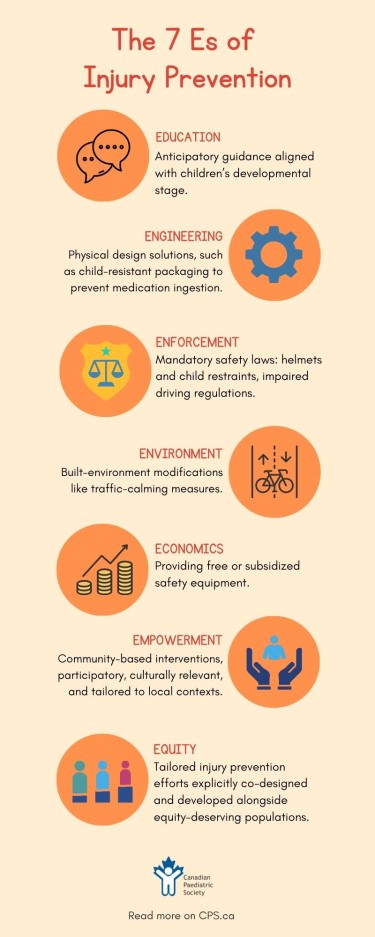
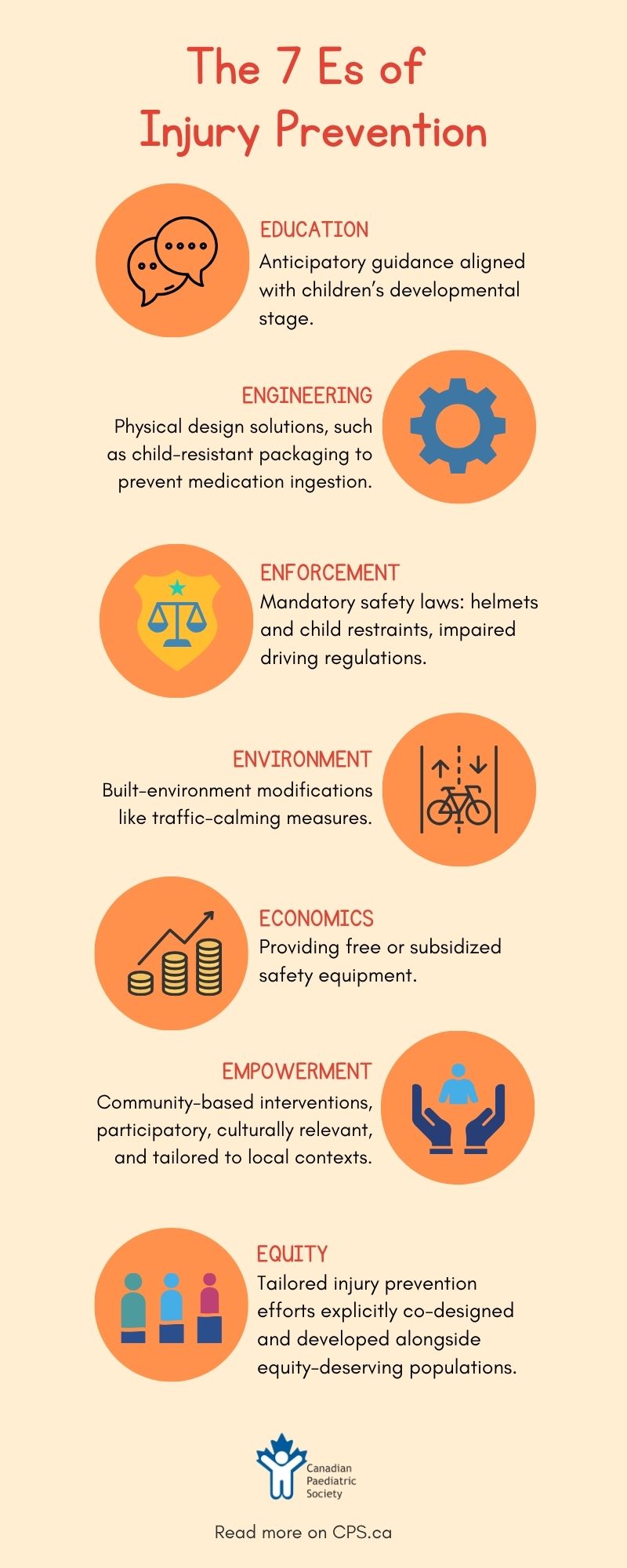
To guide the development and implementation of prevention strategies, injury prevention has traditionally relied on the “3 Es”—Education, Engineering, and Enforcement—but has since evolved into a “7 Es” framework by adding Environment, Economics, Empowerment, and Equity alongside the original pillars[32]. Table 3 summarizes examples of evidence-informed strategies for each of the Es[27][33]-[39].
Table 3. Examples of evidence-informed strategies for the 7 ‘Es’ of injury prevention
|
Education |
Anticipatory guidance aligned with children’s developmental stage[33] |
|
Engineering |
Child-resistant packaging to prevent medication ingestion[34] |
|
Enforcement |
Helmet laws, impaired driving regulations, and child restraint laws[35] |
|
Environment |
Traffic-calming measures such as raised crosswalks, curb extensions, and reduced speed limits[36] |
|
Economics |
Providing free or subsidized safety equipment (such as booster seats, smoke alarms, lock boxes, and bicycle helmets)[37][38] |
|
Empowerment |
Community-based injury prevention interventions that are participatory, culturally relevant, and tailored to local contexts[39] |
|
Equity |
Tailored injury prevention efforts co-designed and developed with equity-deserving populations[27] |
Evidence has shown that public education alone is, generally, insufficient to effect change, while enforcement and environmental reform can each be effective independently. However, combining multiple strategies yields the greatest impacts. For example, Vision Zero, adopted by several Canadian cities, is an international road safety initiative that has demonstrated efficacy in reducing collisions and fatalities through a safe systems approach. Vision Zero has shifted responsibility for improving safety from individuals to transportation system designers and policy-makers using strategies such as environment change (e.g., speed-calming and protected bike lanes), law enforcement, public education campaigns, and planning that prioritizes the safety of vulnerable users[40].
Injury prevention strategies can be both universal (targeting the entire population), or targeted (focusing on specific at-risk groups). While broad approaches, such as promoting smoke alarm use or helmet laws, can improve overall safety, they may not fully reach those living with increased risk levels due to unsafe housing, financial barriers, or other social disadvantages. Targeted strategies that specifically address these inequities, such as free smoke alarm distribution and installation programs in low-income neighborhoods, are essential to ensure that prevention efforts protect those at highest risk[9][41].
Balancing injury prevention and healthy risk-taking in play
Over the past 15 years, research has increasingly shown that developmentally appropriate risk-taking in play (risky play) can support various aspects of children’s well-being, including physical activity, cognition, confidence, emotional regulation, and social skills[42]. To balance opportunities for risk-taking while preventing serious injuries, the literature distinguishes between risks—challenges children can perceive and manage—and hazards, which are dangers that children cannot easily identify and that carry a greater likelihood of serious harm[43]-[45]. For example, climbing on a play structure involves manageable risks, whereas a broken or unstable piece of equipment represents a hidden hazard.
Importantly, the leading causes of child injury mortality (i.e., motor vehicle occupant injuries, burns, pedestrian injuries, and choking) are generally unrelated to free play. When mortality does occur during recreational activities, it is often linked to hazards rather than intentional risk-taking. For example, ORVs pose significant hazards because youth typically lack the developmental capacity to manage speed, terrain, and other environmental factors safely. Similarly, water depth and conditions are hazardous for young children, placing them at high risk for drowning if unsupervised.
Most evidence-informed injury prevention strategies, such as car seats, pool fencing, and child-proof containers, are designed to eliminate hazards rather than restrict opportunities to engage in healthy risk-taking during play, which highlights that injury prevention and risky play are not opposing but complementary in most instances. However, assessing the balance between potential harms and developmental benefits can be challenging for injury mechanisms such as falls or collisions, which are common during free play and sports. This balance can shift depending on context[46]-[49].
Counselling effectiveness and training for paediatric HCPs
Clinical counselling on injury prevention has consistently proven effective[50][51]. A 1993 review found that 18 of 20 studies reported positive outcomes, including increased parental knowledge, safer behaviours and, in some cases, reduced injuries[50]. A 2018 review covering 16 studies from 1991 to 2016 found similar benefits in all but three, including reductions in injuries related to falls, poisoning, burns, traffic incidents, and drowning[52]. While most studies relied on self-reported behaviours, five measured actual injury outcomes, underscoring real-world relevance[52]. Some interventions—particularly in emergency settings—combined counselling with safety equipment distribution (e.g., medication lockboxes), enhancing impact[38]. A recent cluster-randomized trial of the American Academy of Pediatrics (AAP’s) Injury Prevention Program (TIPP) also showed a significant reduction in parent-reported injuries when counselling was delivered during well-child visits[33][51]. This body of evidence highlights the enduring importance of injury prevention counselling in paediatric care.
Despite strong evidence supporting the effectiveness of injury prevention counselling, its consistent delivery in paediatric clinical settings remains a challenge. Paediatric HCPs—whether in primary care or consultant roles—frequently report barriers such as limited time during appointments, competing clinical demands, and insufficient training on injury prevention topics (while acknowledging their importance)[50][51][53]-[55].
Injury prevention remains under-represented in both undergraduate and post-graduate medical education despite its clear relevance to child health across clinical settings[56][57]. A 2018 systematic review found that paediatric and emergency medicine residents—who frequently manage injury-related presentations—often receive limited formal training in this field[58]. While learners overwhelmingly recognized the importance of injury prevention, they reported few structured opportunities to build relevant knowledge and skills. This gap is reflected in Canadian paediatric residency programs, where only three competencies explicitly address injury prevention within national training objectives. Nevertheless, targeted educational interventions have shown clear promise. For example, a dedicated two-week injury prevention curriculum for paediatric residents found significantly improved knowledge retention compared with a control group, both mid-program and at completion[59]. Other structured, interactive programs have similarly demonstrated improvements in learner confidence, attitudes, and understanding of injury prevention strategies[56][60].
Recommendations
For federal, provincial, and territorial governments
- Establish and invest in a pan-Canadian child injury prevention strategy, developed in collaboration with the federal and provincial/territorial governments along with Parachute, Canada’s national injury prevention organization, to provide leadership for policy coordination, surveillance, research, public education, and social marketing. More specifically, this national strategy should:
- Recognize injury as a major preventable public health issue
- Apply the 7 ‘Es’ (Education, Engineering, Enforcement, Environment, Economics, Empowerment, and Equity)
- Align and scale effective prevention efforts across jurisdictions
- Set clear priorities and measurable targets
- Allocate sustainable financial and human resources, both internal and external, to governments
- Assign responsibility for implementation and regular reporting
- Allow provinces and territories to adapt strategies to their contexts while contributing to nationally reportable metrics
- Expand, harmonize, and fund child injury surveillance systems at provincial, territorial, and national levels to enable timely, disaggregated, and shareable data.
For public health organizations
- Ensure all injury prevention efforts address social and structural determinants of health through equity-focused, community-informed approaches, such as by partnering with local organizations serving populations who are disproportionately affected by injuries, or adapting interventions to diverse cultural and socioeconomic contexts.
- Eliminate the use of the term “accident” in all official communications and surveillance systems and replace it with more accurate terms, such as “injury”, “collision”, or “event”, to support prevention efforts and promote accountability.
For injury prevention organizations
- Develop national clinical guidelines and tools for paediatric counselling across health care settings. Guidance should acknowledge the benefits of age-appropriate risk-taking in play while providing evidence-informed strategies to prevent serious injuries.
For paediatric health care providers and organizations
- Integrate paediatric injury prevention as a core competency in health care education through structured, evidence-based training on counselling, advocacy, and prevention, supported by continuing education in collaboration with injury prevention professionals and organizations.
- Support injury prevention counselling in clinical practice by providing access to educational tools and resources in both primary care and emergency department settings, and at high-impact teachable moments, such as after an injury.
- Eliminate the term “accident” in verbal and written communications and data reporting and replace it with more precise terms, such as “injury,” “collision”, or “event”, to reinforce the preventable nature of injuries and align with public health messaging.
Resources
- Parachute – Canada’s national injury prevention organization: https://parachute.ca/en/
- Caring for Kids – The Canadian Paediatric Society’s website for parents and caregivers: https://caringforkids.cps.ca/handouts/safety-and-injury-prevention
- B.C. Injury Research and Prevention Unit: https://www.injuryresearch.bc.ca/
- Injury Prevention Centre, Alberta: https://injurypreventioncentre.ca/
- Atlantic Collaborative on Injury Prevention: https://acip.ca/
Acknowledgement
This statement was reviewed by the Acute Care and Community Paediatrics Committees and by the Social Paediatrics Section Executive of the Canadian Paediatric Society, as well as by representatives of Parachute.
CANADIAN PAEDIATRIC SOCIETY INJURY PREVENTION COMMITTEE (2025-2026)
Members: Daniel Rosenfield MD, MHI (Chair), Hema Patel MD (Board Representative), Suzanne Beno MD (Past Chair), Dominic Allain MD, Kristian Goulet MD, Emilie Beaulieu MD MPH, April Kam MD, Amir Wachtel MD (Resident Member)
Liaisons: Pamela Fuselli (Parachute), André Champagne (Public Health Agency of Canada), April Kam MD (CPS Paediatric Emergency Medicine Section)
Principal authors: Emilie Beaulieu MD MPH, Amir Wachtel MD, Suzanne Beno MD, André Champagne, Daniel Rosenfield MD, MHI
Funding
There is no funding to declare.
Potential Conflict of Interest
All authors: No reported conflicts of interest.
References
- Yao X, Skinner R, McFaull S, Thompson W. Injury hospitalizations in Canada 2018/19. Health Promot Chronic Dis Prev Can 2020;40(9):281-7. doi: 10.24095/hpcdp.40.9.03
- Yao X, Skinner R, McFaull S, Thompson W. At-a-glance – 2015 injury deaths in Canada. Health Promot Chronic Dis Prev Can 2019;39(6-7):225-31. doi: 10.24095/HPCDP.39.6/7.03
- Injury costs across the lifespan – Parachute. January 8, 2026. (Accessed January 22, 2026).
- Peden M, Oyegbite K, Ozanne-Smith J, et al. World Report on Child Injury Prevention. October 3, 2008, Geneva, Switzerland: World Health Organization; 2008. (Accessed January 22, 2026).
- Yanchar NL, Warda LJ, Fuselli P. Child and youth injury prevention: A public health approach. Pediatr Child Health 2012;17(9):511-2. doi: 10.1093/pch/17.9.511
- Golonka RP, Dobbs BM, Rowe BH, Voaklander D. Prevalence and predictors of booster seat use in Alberta, Canada. Can J Public Health 2016;107(2):e155-e160. doi: 10.17269/CJPH.107.5254
- Bruce B, Cramm C, Mundle K, Williams DP, Conrad A. Roadside observation of child passenger restraint use. Adv Pediatr Res 2015;2(24):24. doi: 10.12715/apr.2015.2.24
- Atlantic Collaborative on Injury Prevention (ACIP). The Social Determinants of Injury. April 18, 2011. (Accessed January 22, 2026).
- Trinidad S, Kotagal M. Social determinants of health as drivers of inequities in pediatric injury. Semin Pediatr Surg 2022;31(5):151221. doi: 10.1016/j.sempedsurg.2022.151221
- Ontario Agency for Health Protection and Promotion (Public Health Ontario). Injuries among Children using the Canadian Health Survey on Children and Youth, 2nd edn. April 2024. (Accessed January 22, 2026).
- Mahboob A, Richmond SA, Harkins JP, Macpherson AK. Childhood unintentional injury: The impact of family income, education level, occupation status, and other measures of socioeconomic status. A systematic review. Paediatr Child Health 2019;26(1):e39-e45. doi: 10.1093/PCH/PXZ145
- McClure R, Kegler S, Davey T, Clay F. Contextual determinants of childhood injury: A systematic review of studies with multilevel analytic methods. Am J Public Health 2015;105(12):e37-e43. doi: 10.2105/AJPH.2015.302883
- Ghebreab L, Kool B, Lee A, Morton S. Risk factors of unintentional injury among children in New Zealand: A systematic review. Aust N Z J Public Health 2021;45(4):403-10. doi: 10.1111/1753-6405.13125
- Mytton J, Towner E, Brussoni M, Gray S. Unintentional injuries in school-aged children and adolescents: Lessons from a systematic review of cohort studies. Inj Prev 2009;15(2):111-24. doi: 10.1136/IP.2008.019471
- Zonfrillo MR, Linakis JG, Yang ES, Mello MJ. A systematic review of longitudinal cohort studies examining unintentional injury in young children. Glob Pediatr Health 2018;5:2333794X18774219. doi: 10.1177/2333794X18774219
- Heck M, Sobhan S, Balshaw R, McGavock J. Urban-rural differences in pediatric ATV-related trauma in Canada from 2002-2019: A population-based descriptive study. MedRxiv. July 18, 2025. doi: 10.1101/2025.07.17.25331717
- Möller H, Falster K, Ivers R, Jorm L. Inequalities in unintentional injuries between Indigenous and non-Indigenous children: A systematic review. Inj Prev 2015;21(e1):e144-52. doi: 10.1136/injuryprev-2013-041133
- Pressley JC, Barlow B, Kendig T, Paneth-Pollak R. Twenty-year trends in fatal injuries to very young children: The persistence of racial disparities. Pediatrics 2007;119(4):e875-84. doi: 10.1542/peds.2006-2412
- Putnam-Hornstein E. Report of maltreatment as a risk factor for injury death: A prospective birth cohort study. Child Maltreat 2011;16(3):163-74. doi: 10.1177/1077559511411179
- Harrop AR, Brant RF, Ghali WA, MacArthur C. Injury mortality rates in Native and non-Native children: A population-based study. Public Health Rep 2007;122(3):339-46. doi: 10.1177/003335490712200307
- Reading C, Wien F. Health Inequalities and Social Determinants of Aboriginal Peoples’ Health. Prince George, B.C: National Collaborating Centre for Aboriginal Health; 2009. (Accessed January 22, 2026).
- George MA, Jin A, Brussoni M, Lalonde CE, McCormick R. Injury risk in British Columbia, Canada, 1986 to 2009: Are Aboriginal children and youth over-represented? Inj Epidemiol 2015;2(1):7. doi: 10.1186/S40621-015-0039-2
- UNICEF/For Every Child. Child and adolescent injuries: Road traffic injuries and drowning are leading causes of death worldwide. (Accessed January 22, 2026).
- Davis RM, Pless B. BMJ bans “accidents”. BMJ 2001;322(7298):1320-1. doi: 10.1136/BMJ.322.7298.1320
- Haddon W. Advances in the epidemiology of injuries as a basis for public policy. Public Health Rep 1980;95(5):411-21.
- Haddon W. The changing approach to the epidemiology, prevention, and amelioration of trauma: The transition to approaches etiologically rather than descriptively based. 1968. Inj Prev 1999;5(3):231-5. doi: 10.1136/ip.5.3.231
- Kendi S, Macy ML. The Injury Equity Framework – Establishing a unified approach for addressing inequities. N Engl J Med 2;388(9):774-6. doi: 10.1056/NEJMp2212378
- Cohen JS, Howard MB, McDonald EM, Ryan LM. A call to action: Addressing socioeconomic disparities in childhood unintentional injury risk. Pediatrics 2024;153(4):e2023063445. doi: 10.1542/PEDS.2023-063445
- Centers for Disease Control and Prevention. About The Public Health Approach to Violence Prevention. April 9, 2024. (Accessed January 22, 2026).
- Sleet DA, Hopkins KN, Olson SJ. From discovery to delivery: Injury prevention at CDC. Health Promot Pract 2003;4(2):98-102. doi: 10.1177/1524839902250750
- Crain J, McFaull S, Thompson W, et al. Status report – The Canadian Hospitals Injury Reporting and Prevention Program: A dynamic and innovative injury surveillance system. Health Promot Chronic Dis Prev Can 2016;36(6):112-7. doi: 10.24095/hpcdp.36.6.02
- Gaw C, Beno S, Dodington J, Lee L. Approaches to injury prevention. In: Nagler J, Posner J, Alpern E, et al. Fleisher and Ludwig’s Textbook of Pediatric Emergency Medicine. 9th edn. Alphen aan den Rijn, The Netherlands: Wolters Kluwer; 2026.
- Perrin EM, Skinner AC, Sanders LM, et al. The Injury Prevention Program to Reduce Early Childhood Injuries: A cluster randomized trial. Pediatrics 2024;153(5):e2023062966. doi: 10.1542/peds.2023-062966
- Rodgers GB. The effectiveness of child-resistant packaging for aspirin. Arch Pediatr Adolesc Med 2002;156(9):929-33. doi: 10.1001/archpedi.156.9.929
- Sartin EB, Lombardi LR, Mirman JH. Systematic review of child passenger safety laws and their associations with child restraint system use, injuries and deaths. Inj Prev 2021;27(6):577-81. doi: 10.1136/injuryprev-2021-044196
- Cloutier MS, Beaulieu E, Fridman L, et al. State-of-the-art review: Preventing child and youth pedestrian motor vehicle collisions; Critical issues and future directions. Inj Prev 2021;27(1):77-84. doi: 10.1136/INJURYPREV-2020-043829
- Safe Kids Canada. Child Safety Good Practice Guide: Good Investments in Unintentional Child Injury Prevention and Safety Promotion - Canadian Edition. April 2011. (Accessed January 22, 2026).
- Webb AC, Nichols MH, Shah N, Monroe KW. Effect of lock boxes and education on safe storage of medications. Inj Epidemiol 2020;7(Suppl 1):21. doi: 10.1186/S40621-020-00257-y
- Towner E, Dowswell T. Community-based childhood injury prevention interventions: What works? Health Promot Int 2002;17(3):273-84. doi: 10.1093/HEAPRO/17.3.273
- Kim E, Muennig P, Rosen Z. Vision Zero: A toolkit for road safety in the modern era. Inj Epidemiol 2017;4(1):1. doi: 10.1186/s40621-016-0098-z
- Trinidad S, Kotagal M. Socioeconomic factors and pediatric injury. Curr Trauma Rep 2023;9(2):47-55. doi: 10.1007/s40719-023-00251-x
- Brussoni M, Gibbons R, Gray C, et al. What is the relationship between risky outdoor play and health in children? A systematic review. Int J Environ Res Public Health 2015;12(6):6423-54. doi: 10.3390/IJERPH120606423
- Brussoni M, Brunelle S, Pike I, et al. Can child injury prevention include healthy risk promotion? Inj Prev 2015;21(5):344-7. doi: 10.1136/INJURYPREV-2014-041241
- Gill T, Power M, Brussoni M. Risk-Benefit Assessment for Outdoor Play: A Canadian Toolkit. Ottawa, Ont.: Child & Nature Alliance of Canada; 2029 (Accessed January 22, 2026).
- Brussoni M, Olsen LL, Pike I, Sleet DA. Risky play and children’s safety: Balancing priorities for optimal child development. Int J Environ Res Public Health 2012;9(9):3134-48. doi: 10.3390/ijerph9093134
- Rivara F. Counterpoint: Minor injuries may not be all that minor. Inj Prev 2011;17(3):149-50. doi: 10.1136/injuryprev-2011-040035
- Molcho M, Pickett W. Some thoughts about ‘acceptable’ and ‘non-acceptable’ childhood injuries. Inj Prev 2011;17(3):147-8. doi: 10.1136/ip.2010.030023
- Langley J, Cryer C. A consideration of severity is sufficient to focus our prevention efforts. Inj Prev 2012;18(2):73-4. doi: 10.1136/injuryprev-2011-040278
- Pless IB. Commentary: On preventing all injuries. Inj Prev 2012;18(5):285-6. doi: 10.1136/injuryprev-2012-040449
- Bass JL, Christoffel KK, Widome M, et al. Childhood injury prevention counseling in primary care settings: A critical review of the literature. Pediatrics 1993;92(4):554-50.
- Gardner HG, AAP Committee on Injury, Violence, Poison Prevention. Office-based counseling for unintentional injury prevention. Pediatrics 2007;119(1):202-6. doi: 10.1542/peds.2006-2899
- Zonfrillo MR, Gittelman MA, Quinlan KP, Pomerantz WJ. Outcomes after injury prevention counselling in a paediatric office setting: A 25-year review. BMJ Paediatr Open 2018;2(1):e000300. doi: 10.1136/bmjpo-2018-000300
- Gaw CE, Berthet E, Curry AE, Zonfrillo MR, Arbogast KB, Corwin DJ. Pediatric health care provider perspectives on injury prevention counseling in acute and primary care settings. Clin Pediatr (Phila) 2020;59(13):1150-60. doi: 10.1177/0009922820941237
- Bass JL. Effectiveness of injury prevention counseling. Inj Prev 1995;1(3):146. doi: 10.1136/ip.1.3.146
- Woods AJ. The role of health professionals in childhood injury prevention: A systematic review of the literature. Patient Educ Couns 2006;64(1-3):35-42. doi: 10.1016/J.PEC.2005.12.011
- Zosel A, Kohlbeck S, Davis CS, Meurer L, Hargarten S. Medical student education for injury prevention: Closing the gap. Inj Prev 2021;27(2):201-5. doi: 10.1136/injuryprev-2020-043759
- Yoshii I, Sayegh R, Lotfipour S, Vaca FE. Need for injury-prevention education in medical school curriculum. West J Emerg Med 2010;11(1):40-3.
- Schmitz E, Figueira S, Lampron J. Injury prevention in medical education: A systematic literature review. J Surg Educ 2019;76(3):700-10. doi: 10.1016/j.jsurg.2018.10.009
- Gittelman MA, Pomerantz WJ, Schubert CJ. Implementing and evaluating an injury prevention curriculum within a pediatric residency program. J Trauma 2010;69(4 Suppl):S239-44. doi: 10.1097/TA.0b013e3181f1ed63
- Sangvai S, Mahan JD, Lewis KO, Pudlo N, Suresh S, McKenzie LB. The impact of an interactive Web-based module on residents’ knowledge and clinical practice of injury prevention. Clin Pediatr (Phila) 2012;51(2):165-74. doi: 10.1177/0009922811419027
Disclaimer: The recommendations in this position statement do not indicate an exclusive course of treatment or procedure to be followed. Variations, taking into account individual circumstances, may be appropriate. Internet addresses are current at time of publication.